Cognizant Project Leap (April 29 2026, $200-270M severance pool) is killing the same SOW line items filling 40-60% of an Indian SME's monthly IT vendor invoice — billed at 40-60% margin, often by a regional SI on a contract that auto-renews. Here's the audit before that contract closes again.
The Cognizant Memo Is Sitting On Your Vendor Invoice
A founder we spoke with last week runs a 32-person specialty chemicals trading firm out of Andheri. Last Tuesday she opened the news, read the Cognizant Project Leap headline, then opened her last vendor invoice from the regional SI that has serviced her office since 2022.
₹2.4 lakhs that month. Line one: managed IT support for 30 users. Line two: hardware AMC. Line three: ten hours of "value-added advisory." Line four: T&M project work, billed at ₹2,000/hour, 10 hours, no timesheet attached.
She wasn't worried about the bill. She was worried because she suddenly couldn't tell which lines were paying for the strategic work she actually depends on, and which were paying for tasks that her vendor's own delivery managers — sitting one floor above the L1 helpdesk in a Pune ODC — were about to be cut for.
That is the actual story of Cognizant's April 29 announcement. Not the layoffs. Not the $200-270M severance pool. The fact that the SOW line items being killed inside Cognizant are the same line items filling 40-60% of every Indian SME IT vendor invoice — billed at 40-60% margin, often by a regional SI on a contract that quietly auto-renews next quarter.
What Cognizant Just Told The Market About Your Vendor
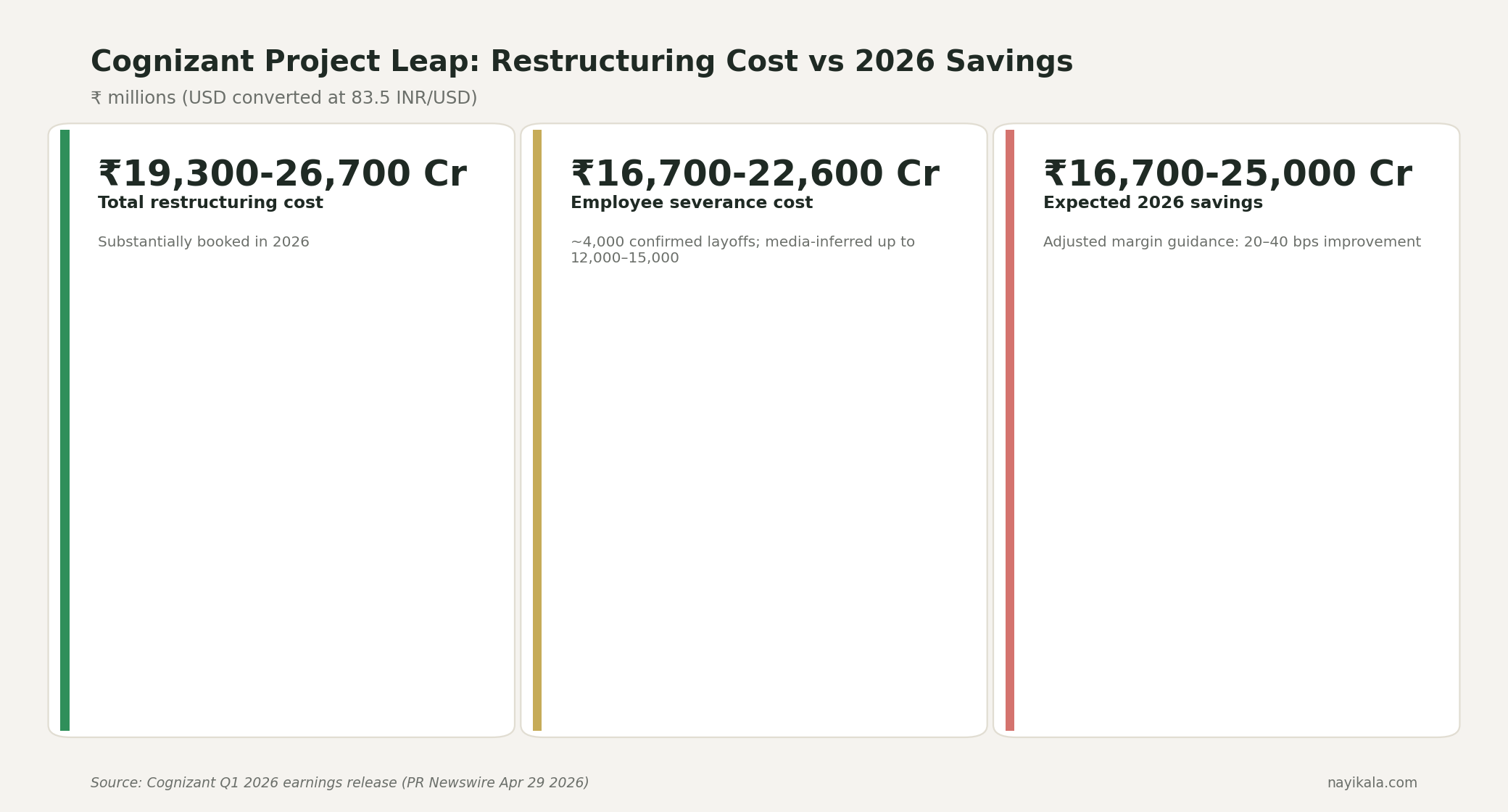
CEO Ravi Kumar S used the phrase "rightsizing the pyramid" four times on the Q1 2026 earnings call (Motley Fool transcript, April 29). Project Leap allocates $200-270M to severance, with media-modeled headcount impact of 12,000-15,000 (Business Standard back-calc from severance pool ÷ Indian average salary; company has confirmed only ~4,000). The named targets: mid-level application maintenance, BPO, and traditional IT support.
This isn't isolated.
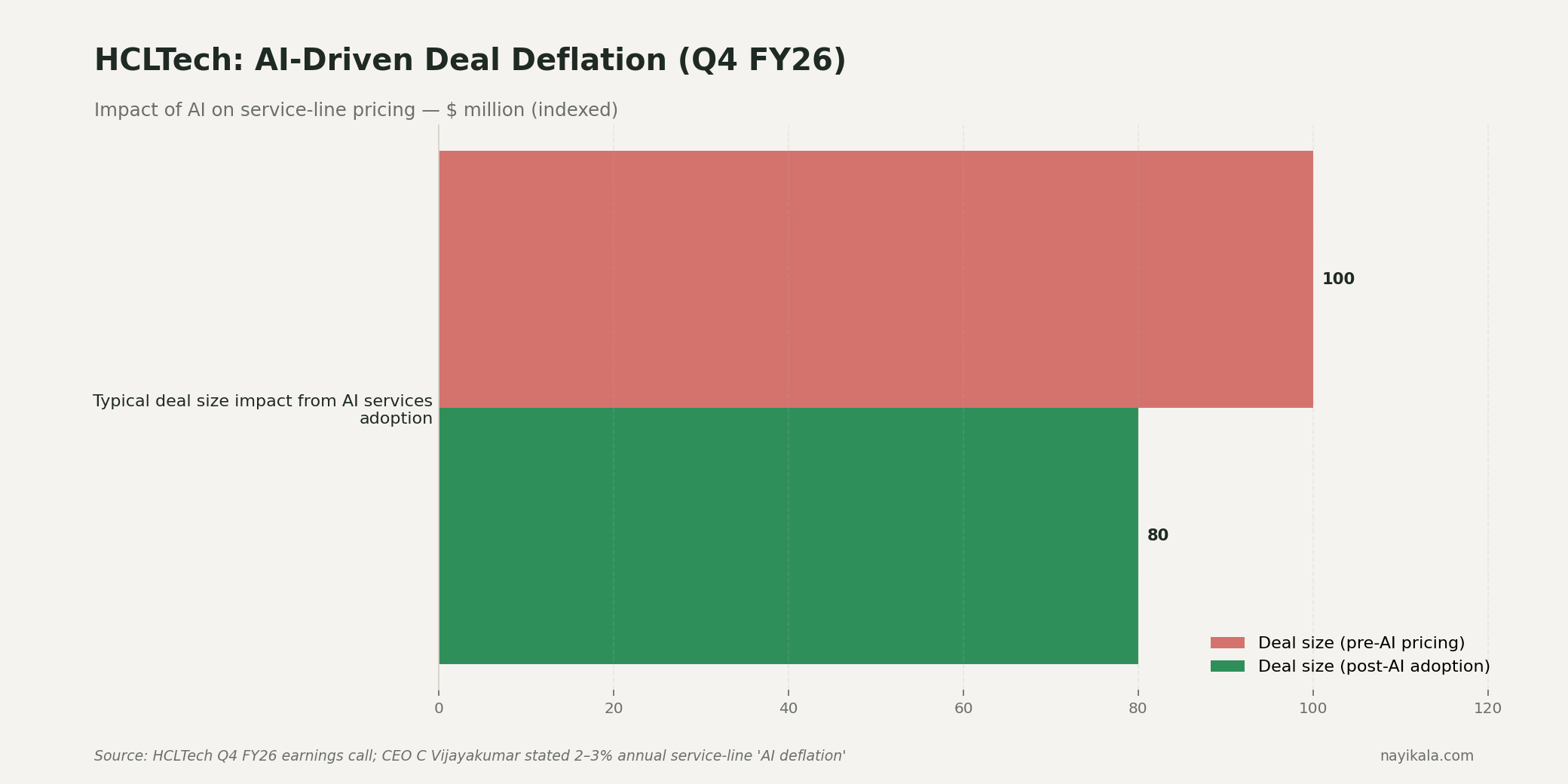
HCLTech's CEO C Vijayakumar, on the same earnings cycle, gave the cleanest one-line summary of what is happening to services pricing: "Deals that were earlier sized at $100 million now being signed closer to $80 million." He called it 2-3% annual "AI deflation" on the services line. (The Register, April 28 2026.)
Accenture's Julie Sweet went further last September — dumped $865M in deals before signing, citing "declining demand for conventional consulting" (CNBC, September 2025).
Globally: 961 tech layoffs per day in 2026, up from 674/day in 2025. 20.4% of those layoffs explicitly AI-attributed, up from under 8% the year before (TrueUp tracker, May 7 2026; CNBC analysis through early March). India's top-5 IT firms shed a net 6,981 employees in FY26 on official results.
Read those numbers in one direction: the BPO/ADM layer of Indian IT services is being repriced down by the people who built it. Read them the other direction — the direction that matters for your P&L — and they tell you that the part of your monthly invoice your vendor is least eager to defend is the part you are most likely overpaying for.
The Anatomy Of The Invoice You Are Probably Not Reading
Here is what a 30-person SME's monthly IT invoice from a regional SI typically looks like, with India 2025-26 published rates (Zenkins, GR IT Services, EZTax, Wisemonk benchmarks):
- Managed IT support, 30 users × ₹3,500: ₹1,05,000
- Server + network AMC (1 server, firewall, 2 switches): ₹5,000
- ERP support AMC (Tally or Zoho One): ₹5,000-15,000
- Software license markup (10-20% on ₹50K SaaS pass-through): ₹5,000-10,000
- Project T&M, 10 hours @ ₹2,000: ₹20,000
- "Value-added" advisory / vCISO retainer: ₹10,000-25,000
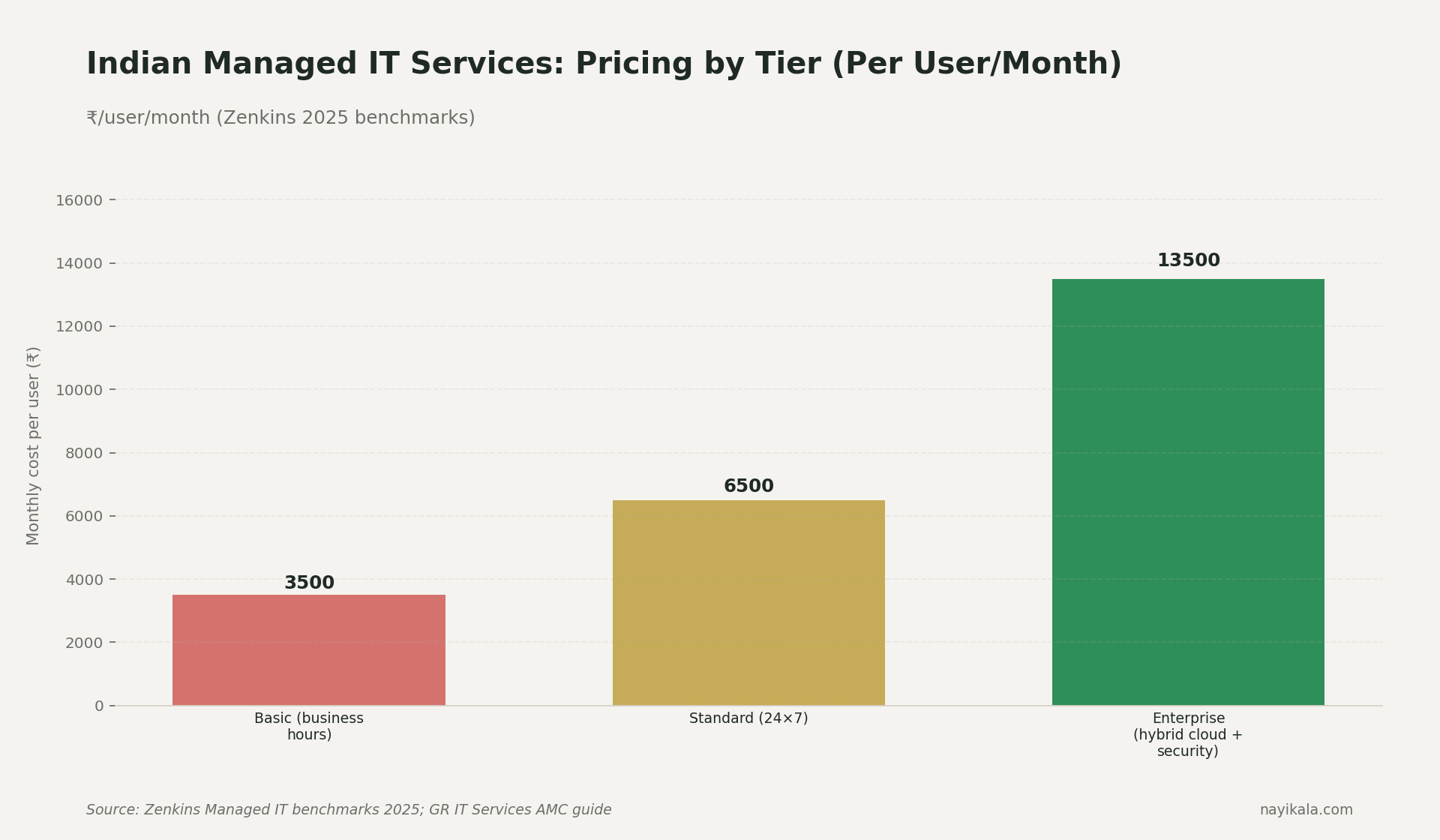
Total: ₹1.5-2 lakhs/month, scaling to ₹2.5-4L for 50-user offices.
Now the part the invoice doesn't show.
That ₹3,500/user managed IT line is mostly L1 helpdesk — password resets, software installs, printer issues. The vendor's internal cost for that L1 engineer is ₹25,000-40,000/month. They bill you ₹50,000-70,000 per resource. That is a 40-60% gross margin on tickets where 30-40% of the volume is already automatable today through any decent ITSM router with an LLM front-end.
Hardware AMC: ₹1.2-1.8 lakhs/year for a 20-laptop office with one server and a firewall. In the vendor invoices we've audited, the AMC line is mostly insurance pricing — tickets are rare, response is mostly courier logistics, the markup is vendor margin.
SAP B1 if you run it: AMC = 22% of license cost, annually, forever. A ₹15L 5-user perpetual license bills ₹3.3L/year just to keep the support contract active.
Payroll PEPM: ₹150-2,500 per employee per month nominal — but real-world all-in invoices run 40-60% above quote (Wisemonk, 2025) once you add multi-state surcharges, ad-hoc filings, setup fees. A 30-person SME quoted ₹500 PEPM ends up at ₹2-2.5 lakhs/year.
GST filing: ₹500-5,000 per return, per GSTIN. A ₹20 Cr manufacturer with two GSTINs is at ₹72,000-1.44L/year on GST compliance alone — for filings ClearTax-class tools claim handle in 70% less time.
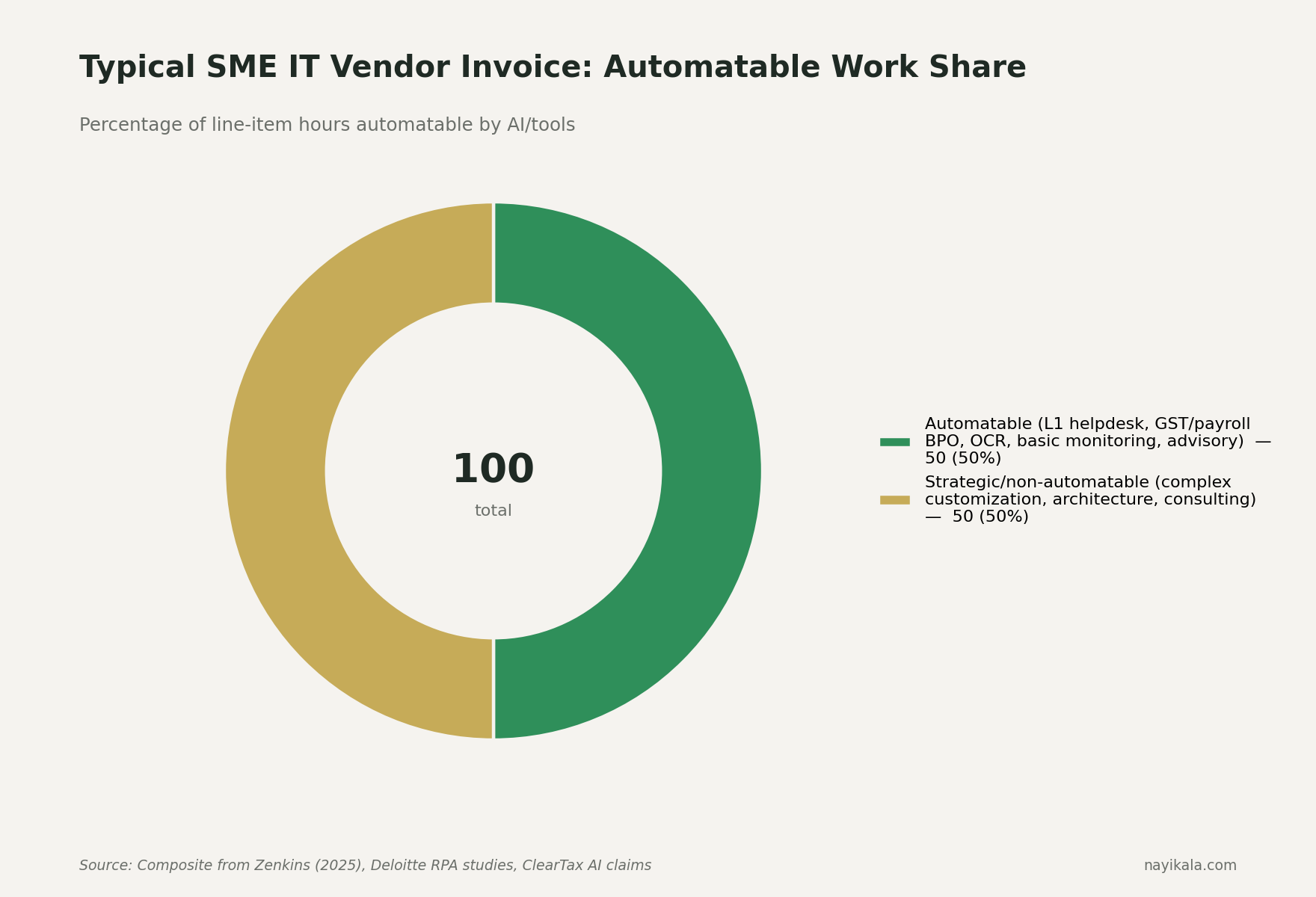
Stack-rank that invoice across analyst-published automation potential (Deloitte invoice OCR data: 98% accuracy, 80% processing reduction; ClearTax GST: 70% time saving; published L1 helpdesk automation: 30-40%) and the composite is consistent across every SME we've audited: 40-60% of the line items are work that an LLM router, an OCR pipeline, and a 2-person automation team will do faster, cheaper, and with a real audit trail.
What An Honest 24-Month Replacement Looks Like
A 2-person team you actually own: one mid-level backend engineer (₹15 LPA CTC, all-in × 1.3 = ₹1.63L/month), one junior-mid full-stack/DevOps (₹10 LPA, ~₹1.08L/month).
Tooling for that team, pragmatic SaaS-hybrid stack:
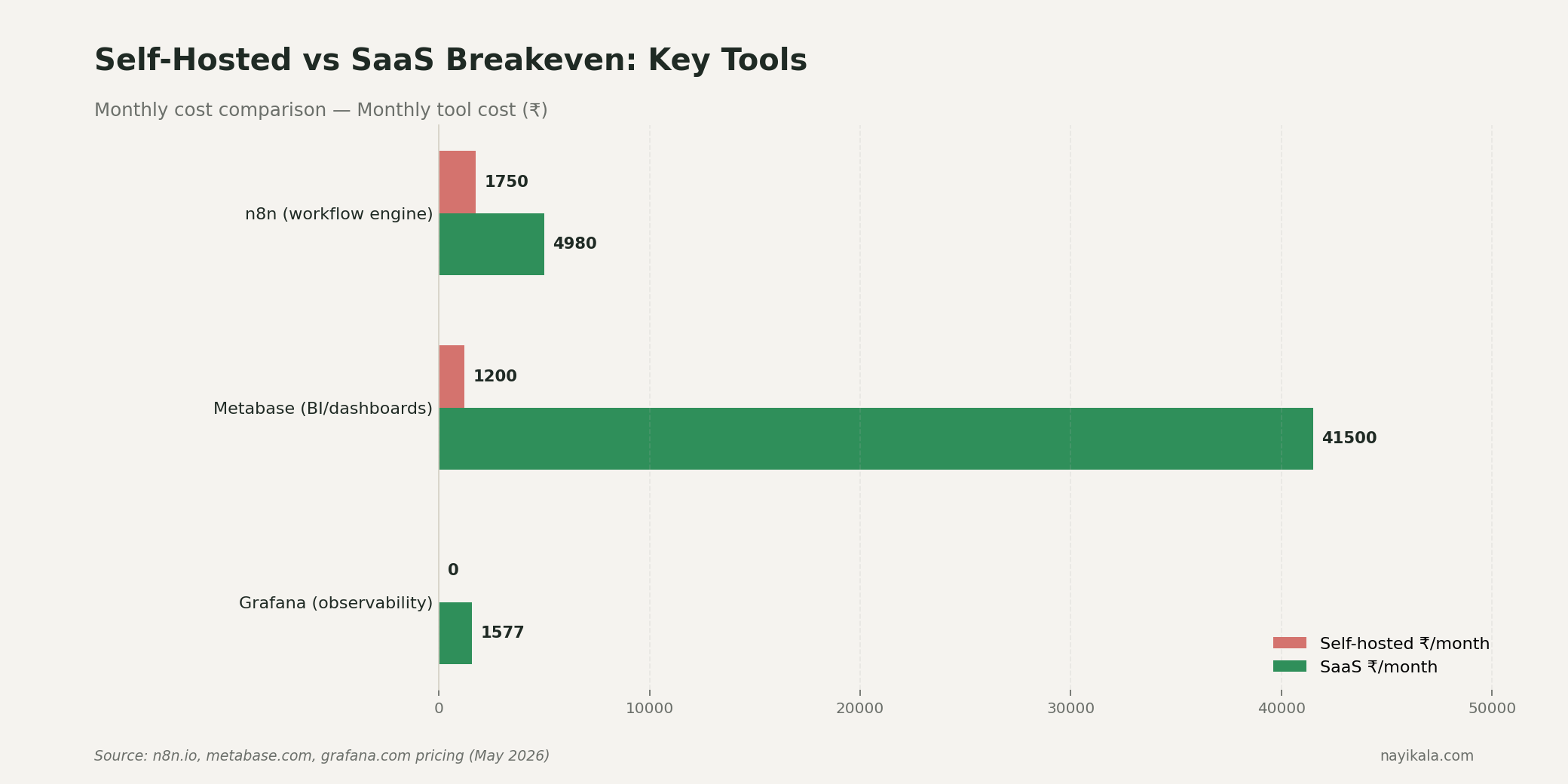
- n8n self-hosted on a ₹1,000-2,500/month VPS (replaces UiPath at ₹35,000-42,000/month for a 20-workflow shop)
- Grafana Cloud free tier (10K series, 50GB logs, 3 users — covers most SME monitoring at ₹0)
- Metabase OSS self-hosted for dashboards (₹0 license vs vendor Power BI retainer at ₹40,000-1.5L/month)
- GitHub Actions free tier (2,000 build min/month) + Playwright on the same runner
- AWS Textract for OCR at $1.50 per 1,000 pages — 5,000 invoice pages/month costs ₹625
All-in tooling: ₹15,000-30,000/month.
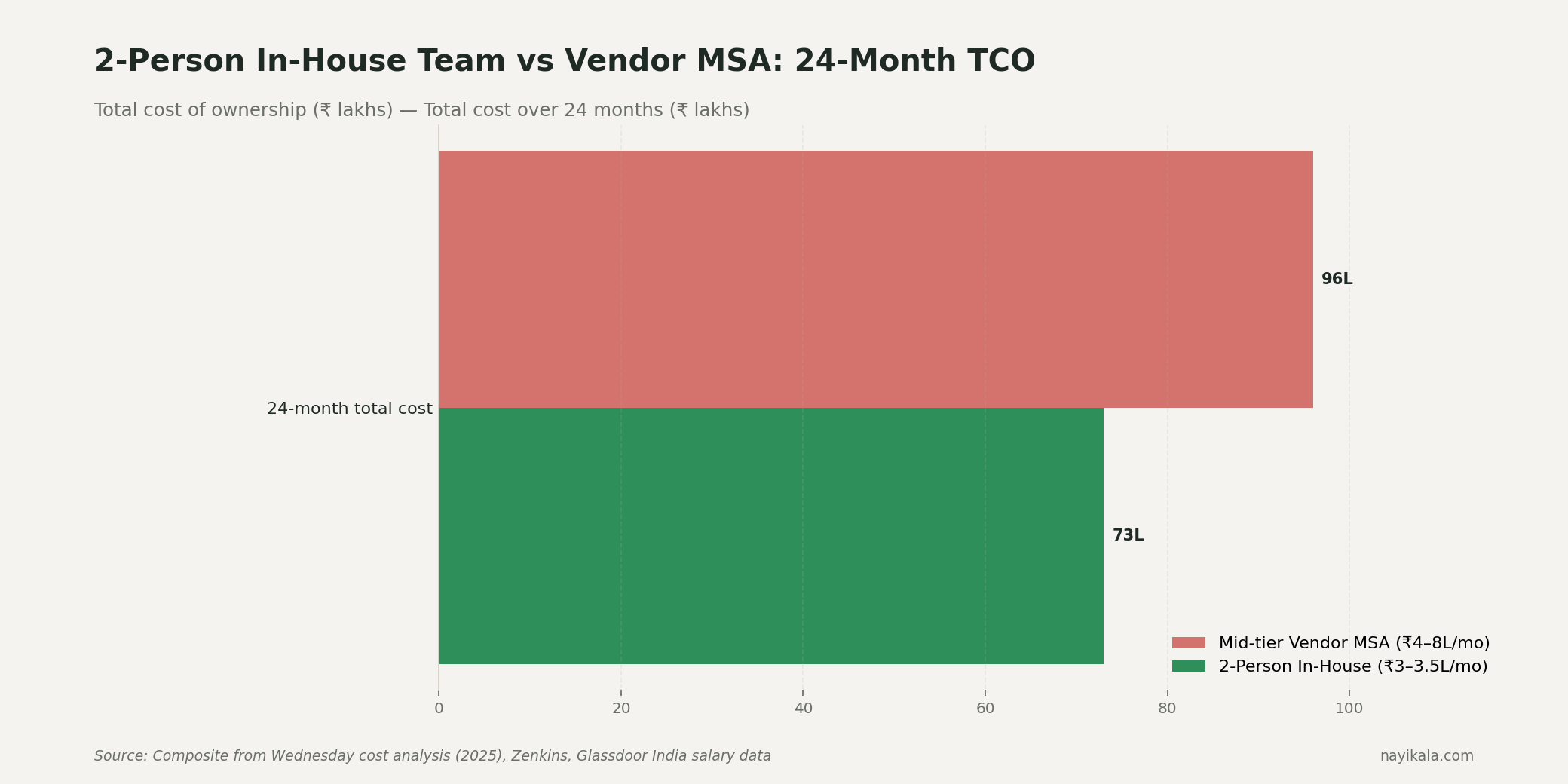
Total monthly burn for the in-house team: ₹3-3.5 lakhs/month, all-in, including laptops and overhead.
Comparable mid-tier vendor MSA for two equivalent FTEs (L2 + L3 with PMO and tooling overhead): ₹4-8 lakhs/month.
24-month TCO: in-house ₹73-86L vs vendor MSA ₹96-196L. Against a ₹4L/month MSA the breakeven is month 2. Against ₹8L/month, the NPV saving over 24 months exceeds ₹1 crore.
The number that matters more than the savings: knowledge stays in the building. Every workflow, every prompt, every piece of integration code, every escalation rule. When the vendor leaves — and at the current pace of consolidation, more vendors will leave than you choose to leave — none of it walks out with them.
The Compliance Teeth That Bite Today, Not In 2027
The vendor audit you should run this quarter is not really an IT exercise. It is a tax and compliance exercise. Four things make this urgent in 2026, not 2027.
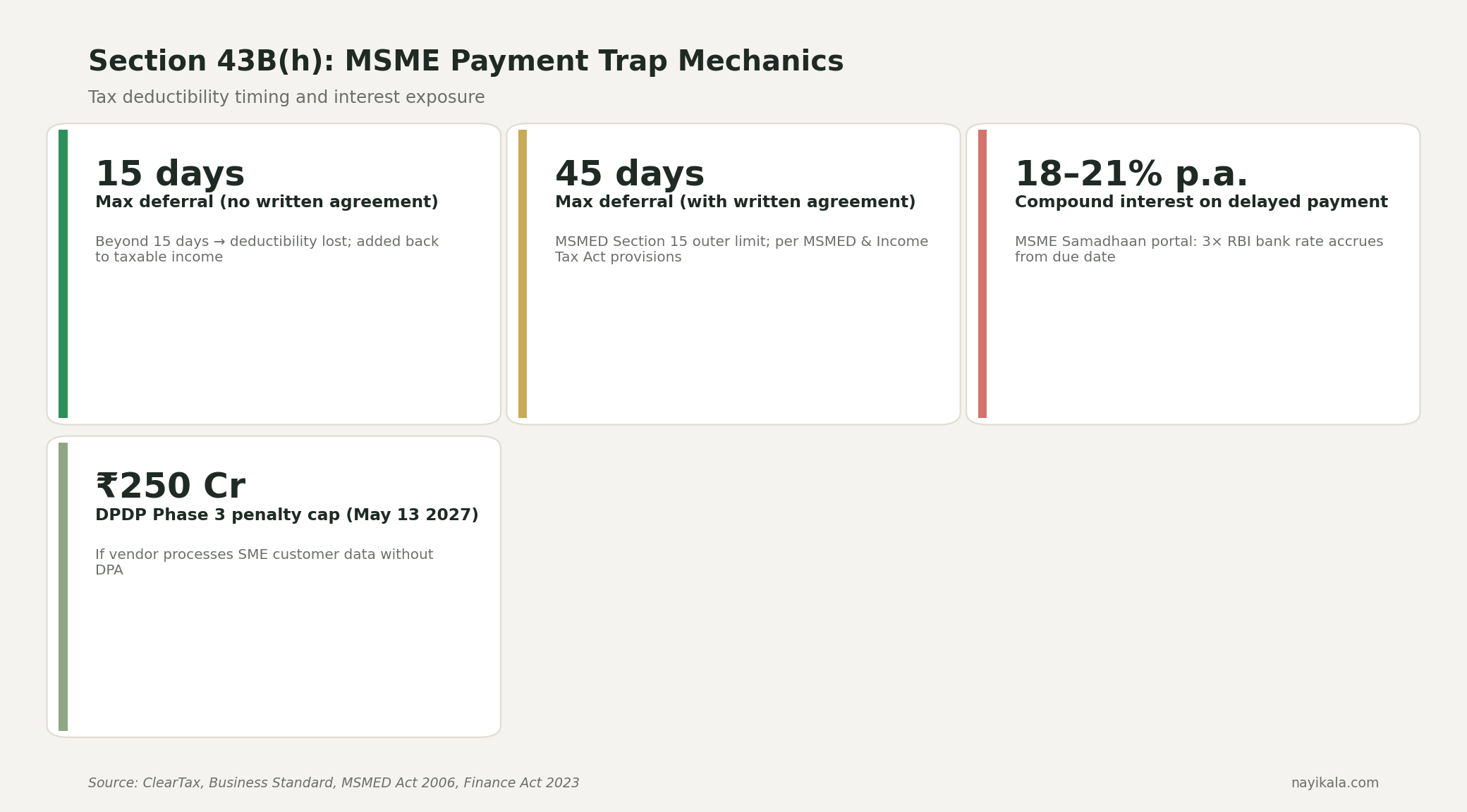
Section 43B(h). Inserted by Finance Act 2023, in force since AY 2024-25. Every unpaid invoice past 45 days to a Micro/Small (Udyam-registered) IT vendor is added back to taxable income, with no cap (ClearTax, Business Standard). The vendor can independently file a delayed-payment complaint on the MSME Samadhaan portal, and 18-21% per annum compound interest accrues from the due date under MSMED Section 16. The 2025 threshold expansion — Small now means up to ₹100 Cr turnover — means many more of your IT vendors are now Small.
Income Tax Act 2025, effective April 1 2026 (last week, in other words). Sections 192-194T are gone. Section 393 with payment codes 1001-1067 replaces them. Filing TDS returns post April 1 with the old 194C / 194J section numbers generates system validation errors (India Briefing, ClearTax). Most vendor SOWs in your drawer cite the old codes.
GST Rule 37A. If your IT vendor files GSTR-1 but doesn't pay GST in their own GSTR-3B, your ITC reverses by November 30 of the following financial year. Your input credit is hostage to your vendor's cash position. Cash-stressed regional SIs in 2026 are exactly the cohort where this triggers (ClearTax).
DPDP Phase 3, May 13 2027. Every IT vendor processing your customer data needs a Data Processing Agreement with documented-instructions clause, breach notification window (CERT-In's 6-hour rule effectively floors this), audit rights, sub-processor flow-down. Penalty cap ₹250 Cr. And the part most fiduciaries miss: you are primarily liable for the Processor's breach. Your vendor's L1 engineer mishandling a customer email is your problem, billed to your bank account.
A Friday Afternoon That Pays For Itself
Pull the last three months of vendor invoices. Open one spreadsheet. Five columns.
-
Tag every line item: Strategic / Operational / Automatable. Be honest. Password resets are not strategic. Quarterly architecture review with the SI's senior architect probably is. The "value-added advisory" line is almost always neither — it is margin recovery on tickets the L1 team handled at no incremental cost.
-
Verify Udyam status of every IT vendor on the Udyam portal. Anyone Udyam-registered, anyone Micro or Small, is a 43B(h) trigger if your payment cycle slips past 45 days. Move them to a stricter payment ledger immediately.
-
Map the MSA termination clauses. Convenience-termination at 30 days, 90 days, or 6 months? Are there liquidated damages clauses (3-6 months of remaining SOW value is the common SME trap)? Is there a binding SLA on transition assistance, or a soft "best efforts" clause that lets the vendor slow-walk data return on a disputed invoice?
-
Confirm IP assignment in writing. Indian Copyright Act Section 17 default: silent on foreground IP means the author owns it — meaning the vendor, not you. Your custom Tally integration, your bespoke reporting layer, your workflow automations — by default, you have a license, not ownership.
-
Audit who actually does L1. Pull 100 random tickets from last quarter. How many were resolved by humans vs auto-replies? How many took more than five minutes of actual engineer time? Compare to the per-resource billing.
-
For T&M lines: are timesheets verified or is "8 hours/day" just billed? Ask for the engineer-name + task-level breakdown. Vendors can produce this. If yours can't, the question is whether the time was real.
This audit takes a controller half a day. It pays for itself the first month a line item gets cut.
The Reframe
The honest conclusion of this exercise is not "fire your vendor." That is a reductive conclusion that ignores the 10-15% of strategic work — architecture, complex integration, deep ERP customization, escalations the LLM router can't handle — that humans still do better than any tool we have shipped.
Here is what the exercise actually surfaces. Vendors should be billing for that 10-15% at premium rates, with named engineers, documented deliverables, real audit trails. The 40-60% commodity layer either gets repriced down dramatically — to reflect the AI deflation that HCLTech's CEO has already publicly acknowledged — or it gets eaten by 2 in-house engineers, an n8n stack, and a Textract budget that costs less than one quarter of vCISO retainer.
The contract sitting in your filing cabinet, signed in 2023 or 2024, doesn't reflect either reality. It was priced for a world where Cognizant's pyramid still made sense, where L1 margin was defensible, where "value-added advisory" was a real category and not a vendor's polite name for the gap between cost and price. That world ended on April 29.
The line items, the Udyam ledger, and the IP assignment language are where the next twelve months of margin actually lives.
Related reading
← All posts