An SME founder's weekend Excel review used to be a productivity problem. After April 2026, with GST IMS auto-issuing DRC-01C on a Rs 1 lakh mismatch and a 7-day block clock, stale data has become a regulatory one. This is the case for a 6-tile founder dashboard that reads live from Tally, Razorpay, and GSTR-2B.
A founder we know opens her laptop on Saturday morning, pulls the weekly MIS her accountant emailed at 11 PM Friday, and sees that ITC claimed in last month's GSTR-3B was Rs 1.4 lakh higher than what GSTR-2B allowed. By the time she reads the email, the GSTN's Invoice Management System has already issued DRC-01C. The 7-day response clock started on Thursday. She has four days to either pay via DRC-03 with 18% interest or file a documented explanation in DRC-01C Part B — otherwise next month's GSTR-1 and IFF are blocked under CGST Rule 59(6) (per ClearTax's Rule 88D note, cleartax.in/s/rule-88d-cgst-itc-mismatch-gstr-2b-vs-gstr-3b).
That gap — between when the system knew and when she knew — is the entire argument.
For years, the Friday Excel close was a productivity drag: skilled finance talent burning 10 hours a week on spreadsheets (DataRails CFO survey, US/UK, n=200), month-end reconciliation eating 20-50 hours (Ledge 2025, US/UK, n=100), and 71% of Indian MSMEs running spreadsheets alongside their CRM (Zoho 2024 MSME survey, n=5,149). Annoying, but survivable. After April 2026, it is no longer survivable. The compliance stack has stopped waiting for founders to find out on Monday.
The April 2026 Stack That Made Stale Data Dangerous
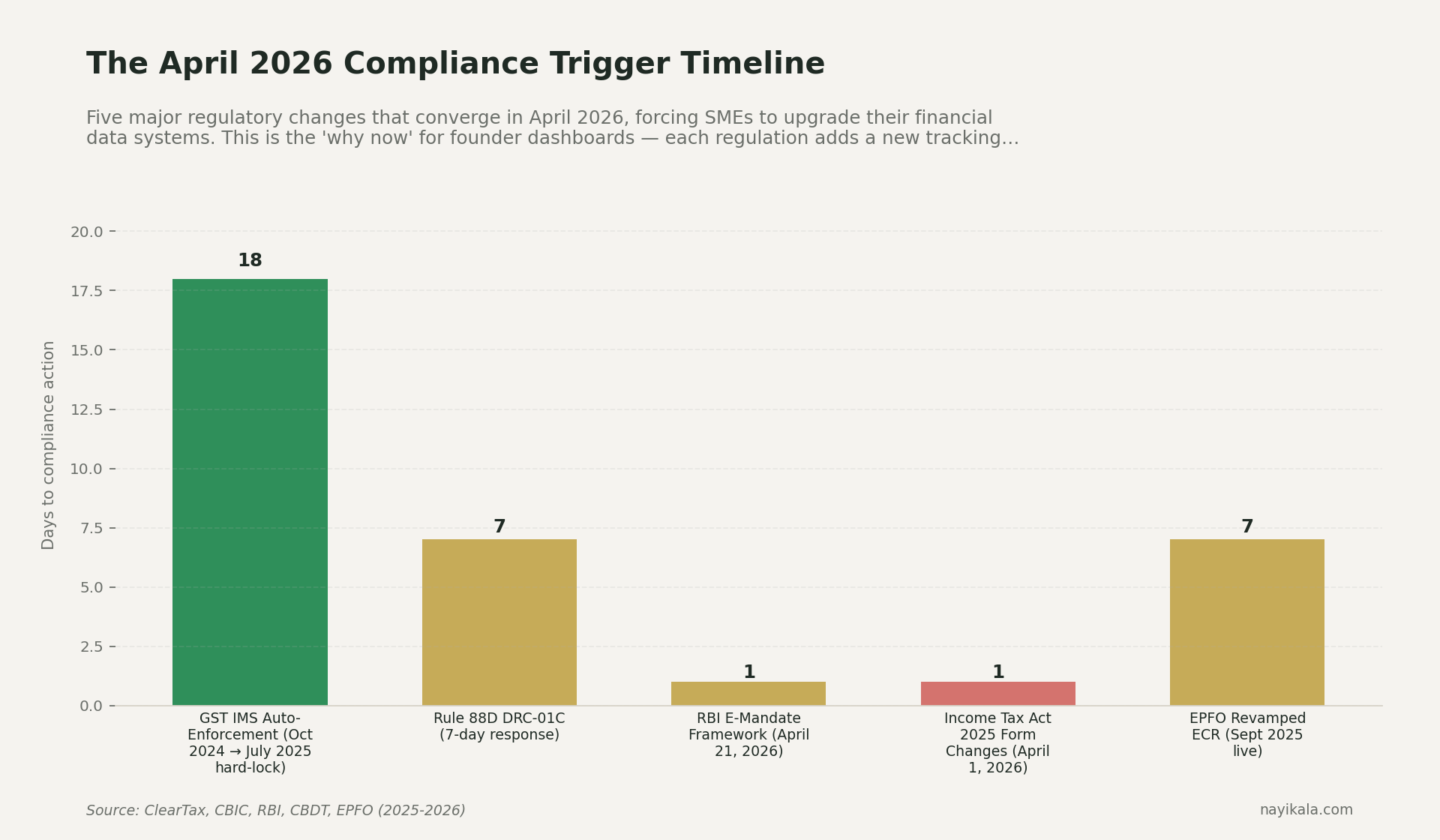
Five things changed in the last twelve months. Any one would matter. Together they rewire what "late" means for a 30-person SME.
GST IMS with teeth. CBIC Notification 16/2025-CT made the Finance Act 2025 amendments to GST law effective October 1, 2025, giving IMS statutory backing under amended Section 38. GSTR-3B Table 3 is now hard-locked. When ITC claimed exceeds GSTR-2B by Rs 1 lakh or 20%, whichever is lower, DRC-01C auto-issues. Miss the 7-day window, your next GSTR-1 is blocked.
RBI E-Mandate Framework 2026, immediate effect April 21. Rs 15,000 cap per recurring transaction without re-authentication; 24-hour pre-debit notifications mandatory (BusinessToday, April 21 2026). When AFA was first rolled out in 2021, ~70% of recurring payments declined the very next month (Inc42 retrospective on India's subscription economy). Any B2B retainer above Rs 15,000/month now needs AFA every cycle. You cannot find out about a failed auto-debit on Monday. You need to know Friday night.
Section 43B(h) at 16.5% compound. RBI bank rate is 5.50% after the April 8, 2026 MPC, so MSMED interest sits at 3× = 16.5% p.a., compounded monthly past Day 45. Worse: unpaid dues to micro/small enterprises are disallowed as a tax deduction in the FY they accrue. The combined hit is 16.5% interest plus 22-30% effective tax on the unpaid amount.
Income Tax Act 2025. From April 1, 2026, Form 16 is Form 130. Section 192 (TDS on salary) is now Section 392. 60+ TDS provisions consolidated under Section 393 with new Numeric Payment Codes 1001-1092. Hardcoded payroll software with old codes throws portal validation errors on upload (ClearTax TDS/TCS April 2026 guide).
EPFO auto-calculation. As of the September 2025 wage month, Section 7Q interest and Section 14B damages (historically 5-25% of delayed dues) are system-computed. Demand notices now auto-generate without an inspector visit (Key4Comply EPFO 2026 update).
Every one of these is a machine that starts counting the moment something mismatches. The Friday Excel is a human checking a week later.
The DSO Math Nobody Shows Founders
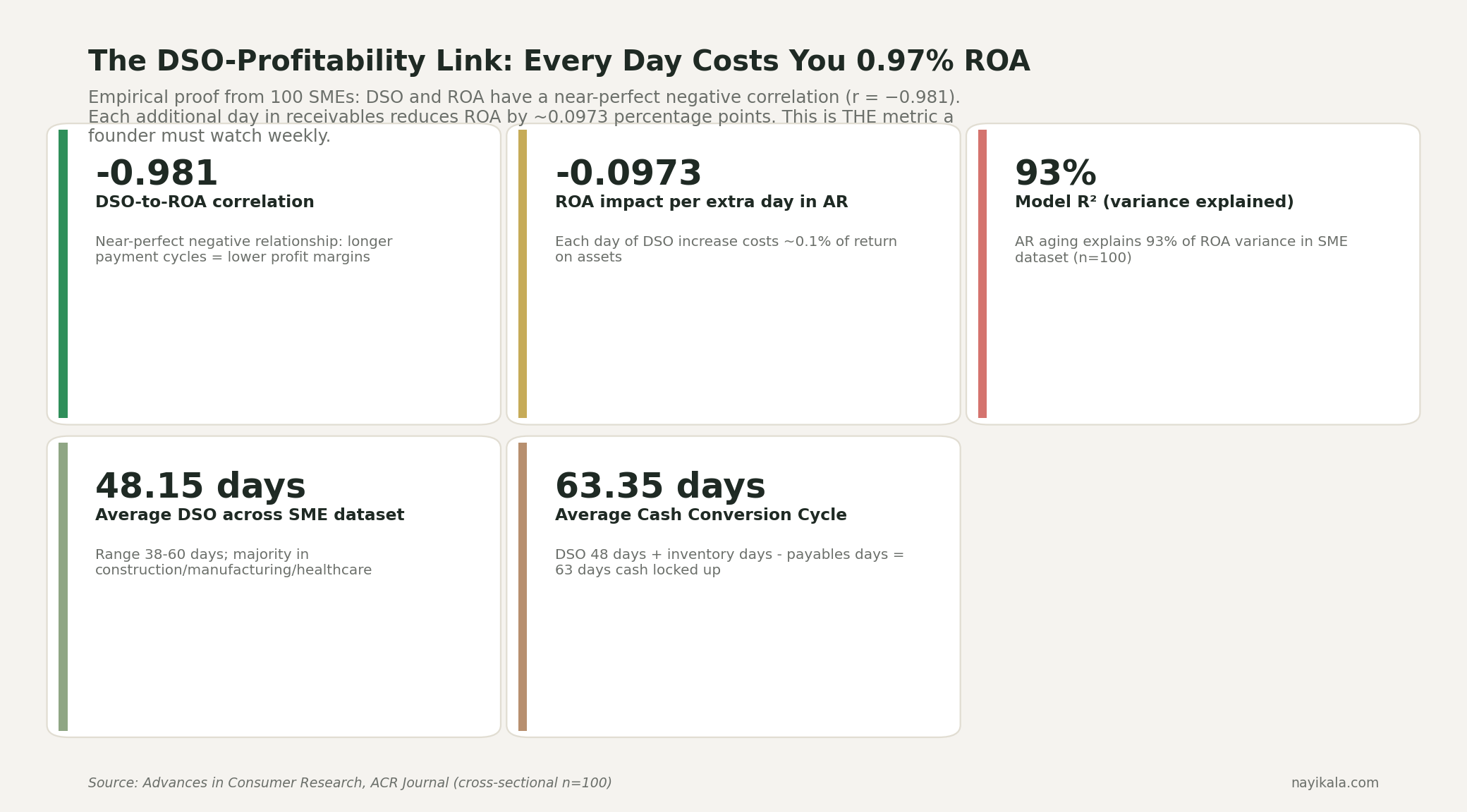
A cross-sectional study of 100 SMEs in the Advances in Consumer Research journal (acr-journal.com) found the mean DSO was 48.15 days and the correlation between DSO and ROA was r = −0.981. Near-perfect negative. Each additional day of receivables dragged ROA down with regression β = −0.0973, p < 0.001. Adjusted R² was 0.93, which is the kind of number you normally only see in lab conditions.
Translate that: AR aging is the single highest-correlation metric with SME profitability in the sample. The founders we've seen without weekly AR visibility are operating blind on what determines their margin.
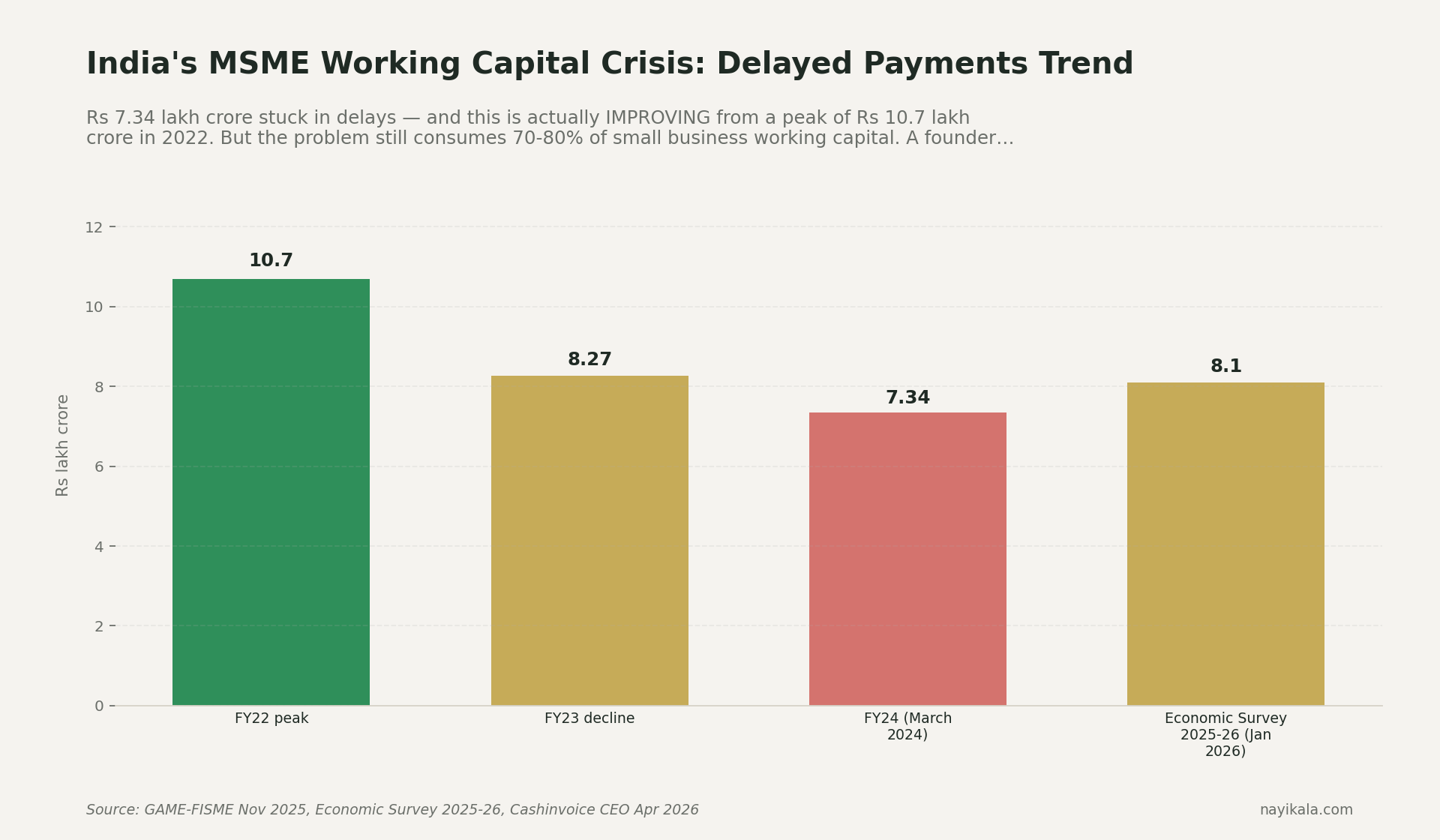
Zoom out and it gets worse. The GAME-FISME Delayed Payments Report 3.0 (November 2025) pegs total delayed payments owed to India's 6.4 crore MSMEs at Rs 7.34 lakh crore (March 2024, inflation-adjusted) — equivalent to 4.6% of India's GVA. Cashinvoice CEO Arun Poojari told Whalesbook in April 2026 that this number consumes 70-80% of small business working capital. PSUs and government agencies account for ~40% of the delays. Micro enterprises face delays 3x longer than larger firms.
If your cash is disproportionately held hostage by your top 5 customers, and you see that concentration only when your CA emails the MIS, you are discovering the most important fact about your business after you can do anything about it.
What Actually Broke: Three Warnings
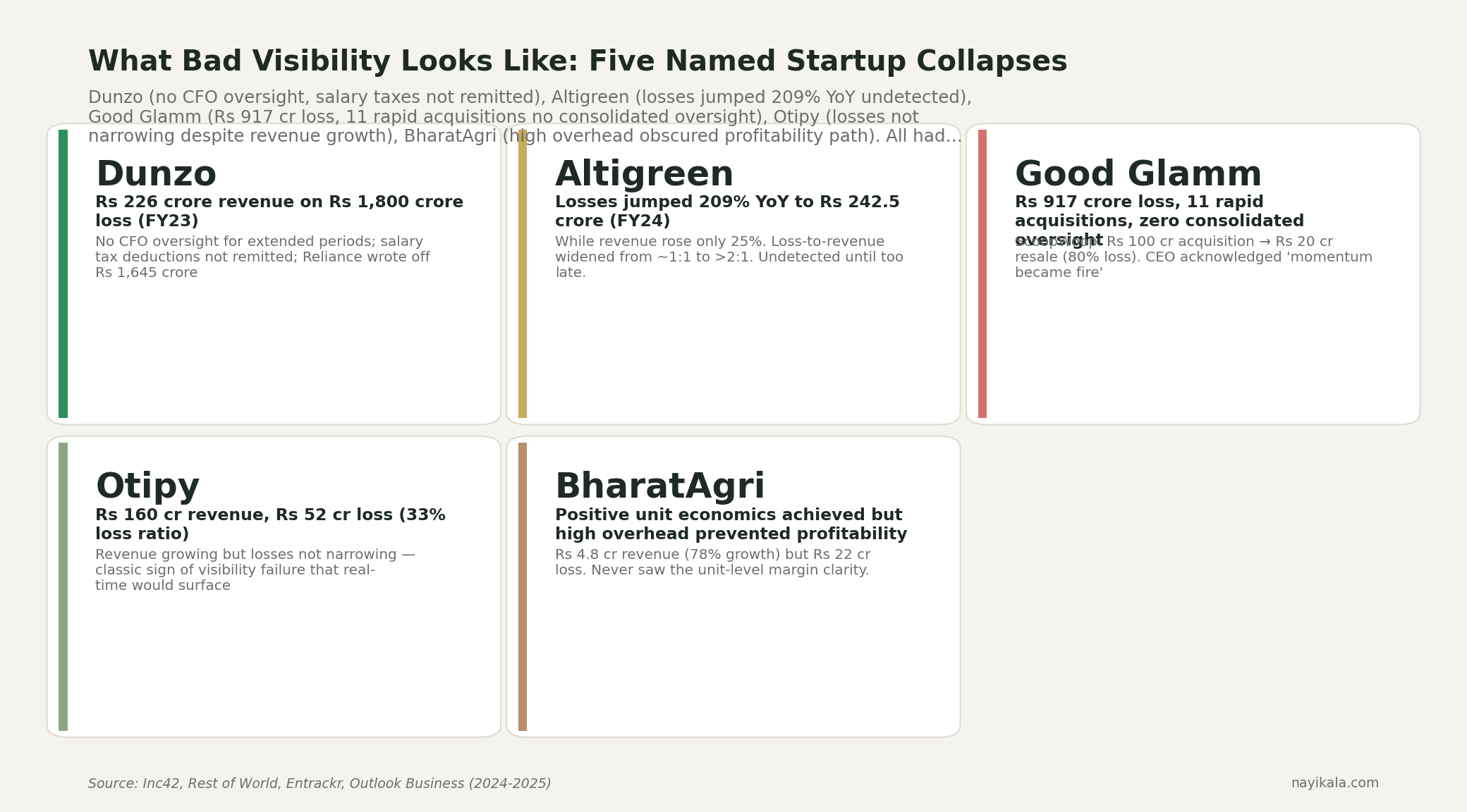
Dunzo operated without a clear CFO for extended periods. Salary payments were missed mid-2023. Government taxes deducted from salaries were not remitted — a direct compliance failure traceable to missing payroll-tax tracking (Rest of World, January 2025). Reliance wrote off the entire Rs 1,645 crore investment. The company had once posted revenue numbers in Slack channels. By the end, nobody inside the building could see the number that mattered until it was a court filing.
Altigreen is the visibility-as-signal story. Losses jumped 209% YoY to Rs 242.5 crore in FY24 while revenue rose only 25% to Rs 119 crore (Inc42). Loss-to-revenue widened from roughly 1:1 to >2:1 in a single year. That slope was knowable in real time from cash-out versus revenue-in on any weekly dashboard. It showed up publicly at year-end filings. Monthly dispatches fell from triple digits to 50-90 units. Plant shut June 2025.
Good Glamm Group CEO Darpan Sanghvi said it directly in an Outlook Business interview (August 2025): "You tell yourself you'll fix the leaks after the next milestone... Soon, you're running from fire to fire, never realising that the whole building is getting hotter." Eleven acquisitions on cheap capital with no integration infrastructure or unified financial oversight. ScoopWoop bought at Rs 100 crore sold for Rs 20 crore — 80% loss. Each individual brand had numbers; the holding company didn't.
All three had reporting. None had Friday visibility that someone with authority acted on.
What You Can Build Monday: The 6-Tile Founder Dashboard
The three-section weekly flash report (liquidity, productivity, profitability; ≤30 minutes to prepare; 80-90% accuracy is enough) has been the practitioner standard for decades — Strategic CFO documented it (strategiccfo.com), but the pattern predates the label. Layered on top of it, the India-specific founder tiles are:
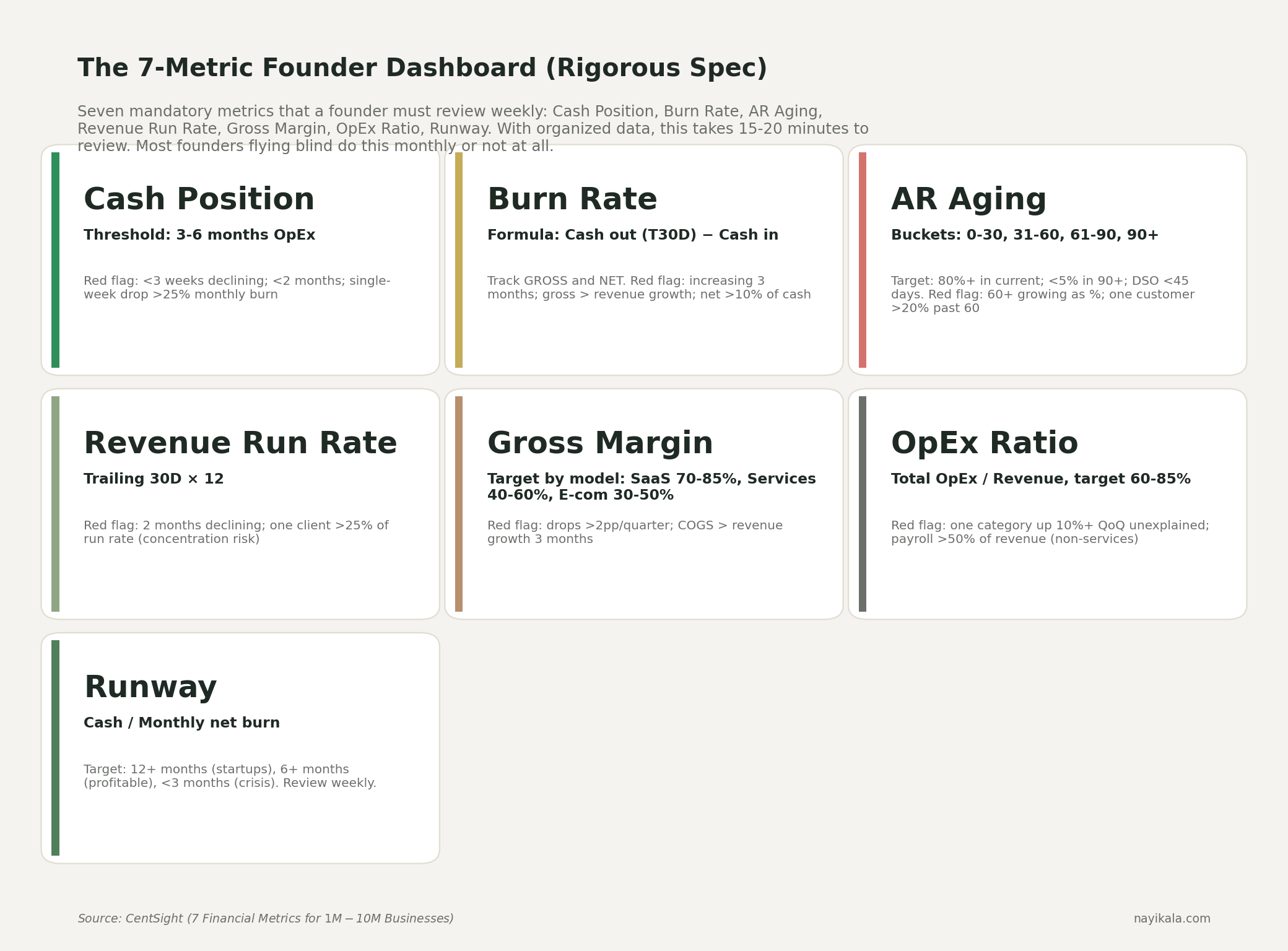
- Cash position — live balance across operating accounts. Red flag: single-week drop >25% of monthly burn.
- AR aging with customer concentration — buckets 0-30, 31-60, 61-90, 90+. Red flag: top-5 customers >50% of receivables, or any one customer >10% of revenue.
- Failed auto-debits (this week) — Razorpay / Cashfree settlement webhook count by failure reason. Red flag: any mandate-related decline on a Rs 15,000+ recurring charge post April 21.
- ITC at risk — GSTR-2B vs claimed-ITC mismatch, approaching the Rs 1 lakh / 20% DRC-01C trigger. Supplier non-compliance list (filers missing GSTR-1).
- MSMED 45-day clock — invoices to micro/small suppliers approaching Day 45, sorted by amount. Dual use: compliance (43B(h) disallowance) and relationship.
- Runway — cash ÷ net monthly burn, trailing three months. Red flag: <6 months for a profitable business, <12 for a growth-stage one.
Dashboards exceeding 12 KPIs show 40% lower engagement (Phoenix Strategy Group) — working memory tops out around 5-9 elements. Six tiles is not a compromise; it is the design.
Spykar Lifestyles (Rs 622 cr revenue FY 2024-25, 900+ stores) went from 7-8 hours of manual Excel per report to the same analysis in minutes after wiring Zoho Analytics into their Microsoft Dynamics AX and in-house POS. Zaaroz runs finance for 55 locations with one chief accountant on the Zoho stack with ICICI connected banking — 100,000+ historical invoices migrated, 100-400 daily invoices now automated via API. Neither built anything exotic. They just stopped re-typing numbers.
How to Actually Plumb It
The plumbing is the unromantic part, and it is where most founder dashboards die.
Tally is the choke point. 75%+ of Indian SMEs run Tally for core accounting (Gartner India 2024). TallyPrime has an HTTP XML server on port 9000 — enable via F1 → Settings → Advanced Configuration → Enable HTTP Server. POST an ENVELOPE/HEADER/BODY XML request, get XML back: trial balance, AR/AP aging, stock summary, vouchers. TallyPrime 6.0 (April 2025) added Connected Banking with 145+ banks but did not introduce REST APIs or webhooks. Port 9000 XML is still the only way in.
Open-source tooling: tally-database-loader (Node.js, github.com/dhananjay1405/tally-database-loader) pushes TDL XML and loads the result to Postgres, MySQL, SQL Server, or BigQuery. tally-integration on PyPI wraps the same thing in Python. TallyConnector abstracts it for .NET.
Razorpay. Settlement recon endpoint returns every payment, refund, transfer, and adjustment settled on a given day. Official Python SDK razorpay-python. Webhook signature verification via HMAC. Cashfree is similar and its webhook analytics dashboard already surfaces error counts and latency.
GSTR-2B. Public APIs for GSTIN validation, e-invoice enablement status. Private APIs (OTP, 30-day token) for GSTR-2B pull, IMS reconciliation. Without a GSP you can still do read operations; filing requires CA or authorized signatory.
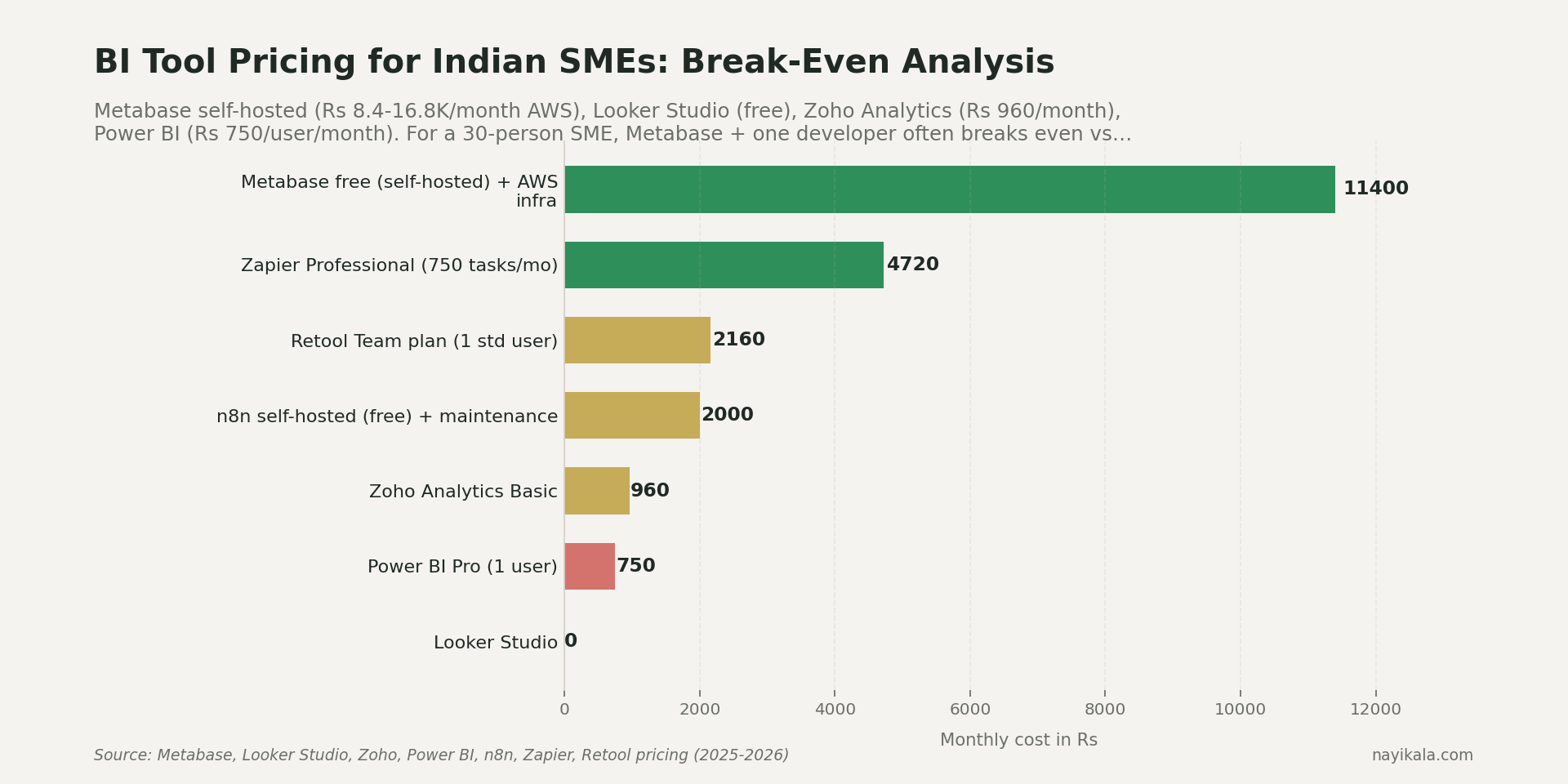
Visualization. Metabase self-hosted on AWS ap-south-1 (Mumbai region, DPDP-relevant) costs roughly Rs 8,400-16,800/month on a t3.medium — ProductGrowth.in benchmark. Setup is 2-5 days for a developer familiar with the stack. Outsourced to a mid-tier Indian dev shop, the whole build lands at Rs 3-5 lakh fixed, per Abbacus Technologies 2025 rates. A Zoho Analytics subscription at Rs 1,500-3,000/month breaks even against the custom build at 15-30 months — so if your team isn't writing SQL, just buy it.
When Not to Build This Yet
OneTribe Advisory (onetribeadvisory.com/knowledge-hub/real-time-reporting) laid out four failure modes honestly. They are worth repeating because they are the engineers-who-build answer, not the sales answer.
- Real-time dashboards nobody watches. If you won't act on Monday's number, daily batch is identical to streaming.
- Data quality harder to maintain at speed. Early real-time deployments often erode trust faster than they build it.
- Real-time before automated batch. That reverses the maturity sequence. Fix the 15-day close to 5 days first.
- Narrow benefits, streaming infra. 15→5 days delivers 80% of the value at a fraction of the cost.
Do not build this dashboard if your Tally entries are 10 days late, if invoices aren't booked, if the bank isn't reconciled, or if no single person owns each metric on the wall. The six tiles are only as honest as the data under them.
The Unresolved Thought
The founder whose accountant emails her Friday night doesn't just lose a week; she loses the shape of her own business — the trend, the acceleration, the quiet second week when AR from her biggest customer started slipping, and the integration between Tally, Razorpay, and GSTR-2B that would have shown her on Wednesday is where the real design decisions live.
Related reading
← All posts