
On April 29, Salesforce shipped Agentforce Operations with a "supplier onboarding" blueprint. The same day, Cognizant announced Project Leap and started cutting the people who used to do that work by hand. Neither move helps an Indian SME, because neither tool knows what a Udyam certificate is.
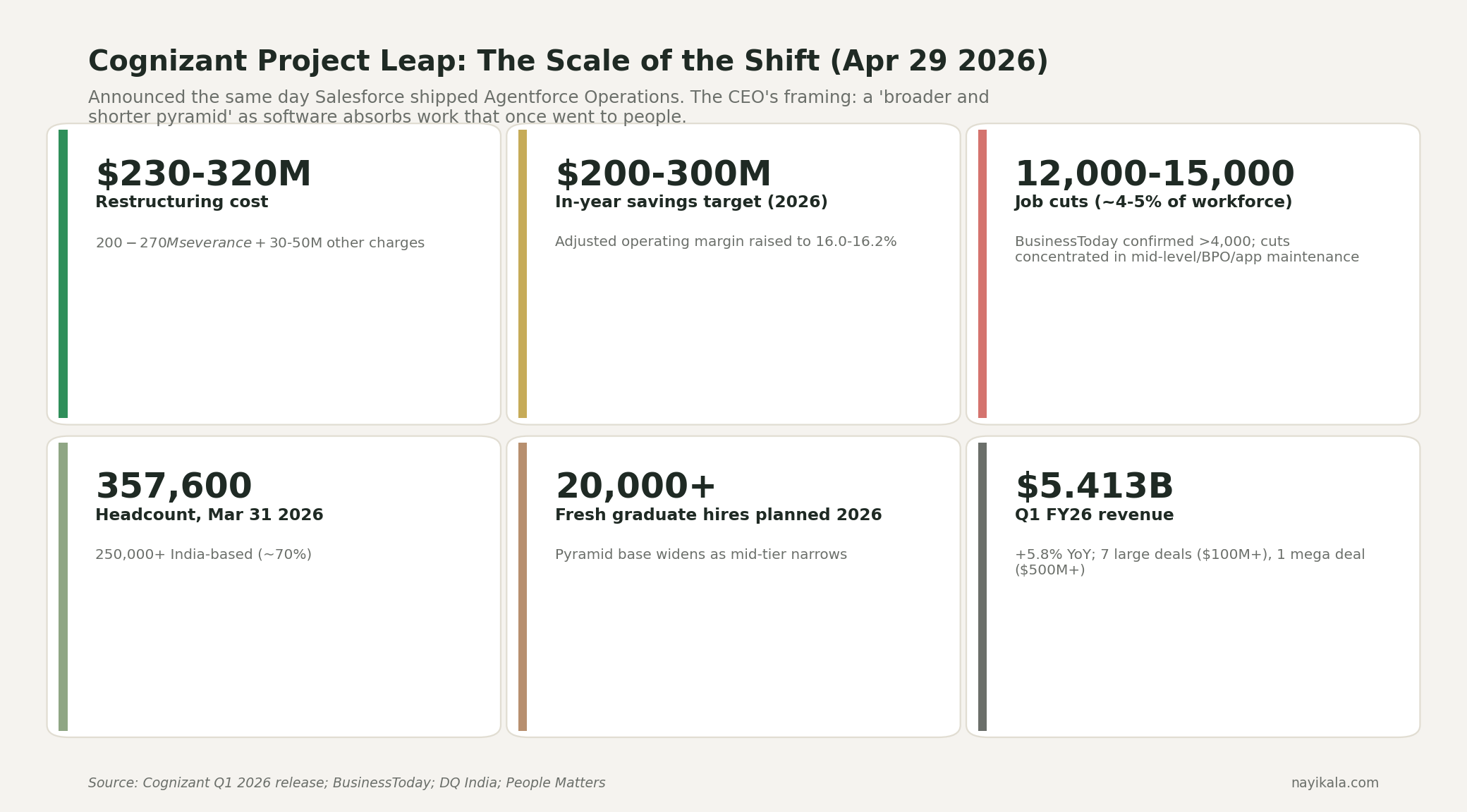
On April 29, 2026, two announcements landed within hours of each other. Salesforce launched Agentforce Operations into general availability with thirty pre-built blueprints — supplier onboarding among them — pricing standard agent actions at $0.10 each (Salesforce Agentforce pricing page, salesforce.com/agentforce/pricing). The same day, Cognizant announced Project Leap: $230-320M restructuring, 12,000-15,000 jobs eliminated, with the CEO openly framing the move as a shift to a "broader and shorter pyramid" because "digital labour, software and AI starts handling jobs that once went to people" (Cognizant Q1 2026 release, news.cognizant.com).
The signal is unambiguous. The work of onboarding a vendor — chasing PAN copies, eyeballing GSTINs, calling banks to confirm a cancelled cheque — is being absorbed into software. The catch, if you run a 30-200 person business in India, is that the software absorbing the work was built for buyers in San Francisco. Coupa's median annual contract value is $95,000 (Vendr Coupa Buyer Guide, vendr.com/buyer-guides/coupa). SAP Ariba supplier network fees alone hit roughly £7,750/year for a vendor processing £5M (Redress Compliance, redresscompliance.com). And neither of them — nor Agentforce — natively validates a GSTIN against GSTN, checks a Udyam category, or runs a penny drop on an Indian bank account. They collect those fields as free text.
The math underneath your finance team's frustration is real. The math underneath their pricing is real too. Both can be true. We've spent the last few months wiring this for ourselves and for a couple of clients, and the gap in the middle is where the actual build sits.
What three weeks of manual onboarding actually costs you
Walk through one cycle. Sales closes a new supplier. Procurement emails a vendor pack: PAN, GST cert, cancelled cheque, Udyam (if MSME), MSA. Two days pass before the vendor's accountant replies. The PAN is a phone photo at an angle. The GST is from 2022 and the registration has since been suspended. Two more chase emails. The cheque is from a current account that doesn't match the GST address. Another email.
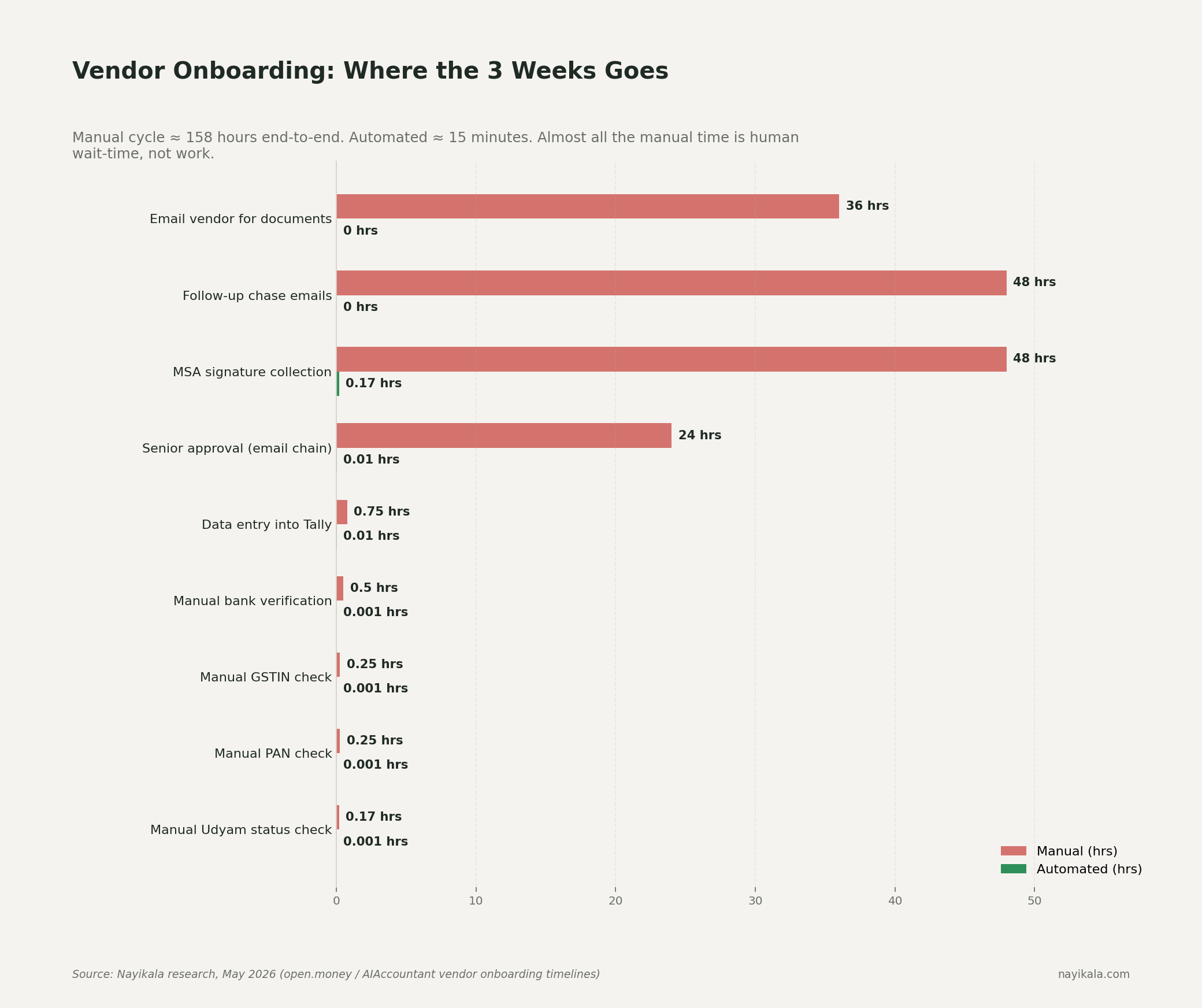
Industry benchmarks for manufacturing vendor onboarding sit at 10-15 business days, with 6-10 chase emails per vendor (ogmarka.com / ifactoryapp vendor automation tracking, ogmarka.com). At an Indian procurement analyst loaded cost of roughly ₹264/hour (Glassdoor base ₹5.5L/yr), ten hours of touchwork comes to ~₹2,640 per vendor in direct labor alone — call it ₹2.64L/year if you onboard 100 vendors a quarter. That's before the indirect cost: invoices that bounce because the GSTIN was inactive, ITC denied because the vendor was IRP-mandated and didn't generate an IRN, and the bigger one nobody books — Section 43B(h).
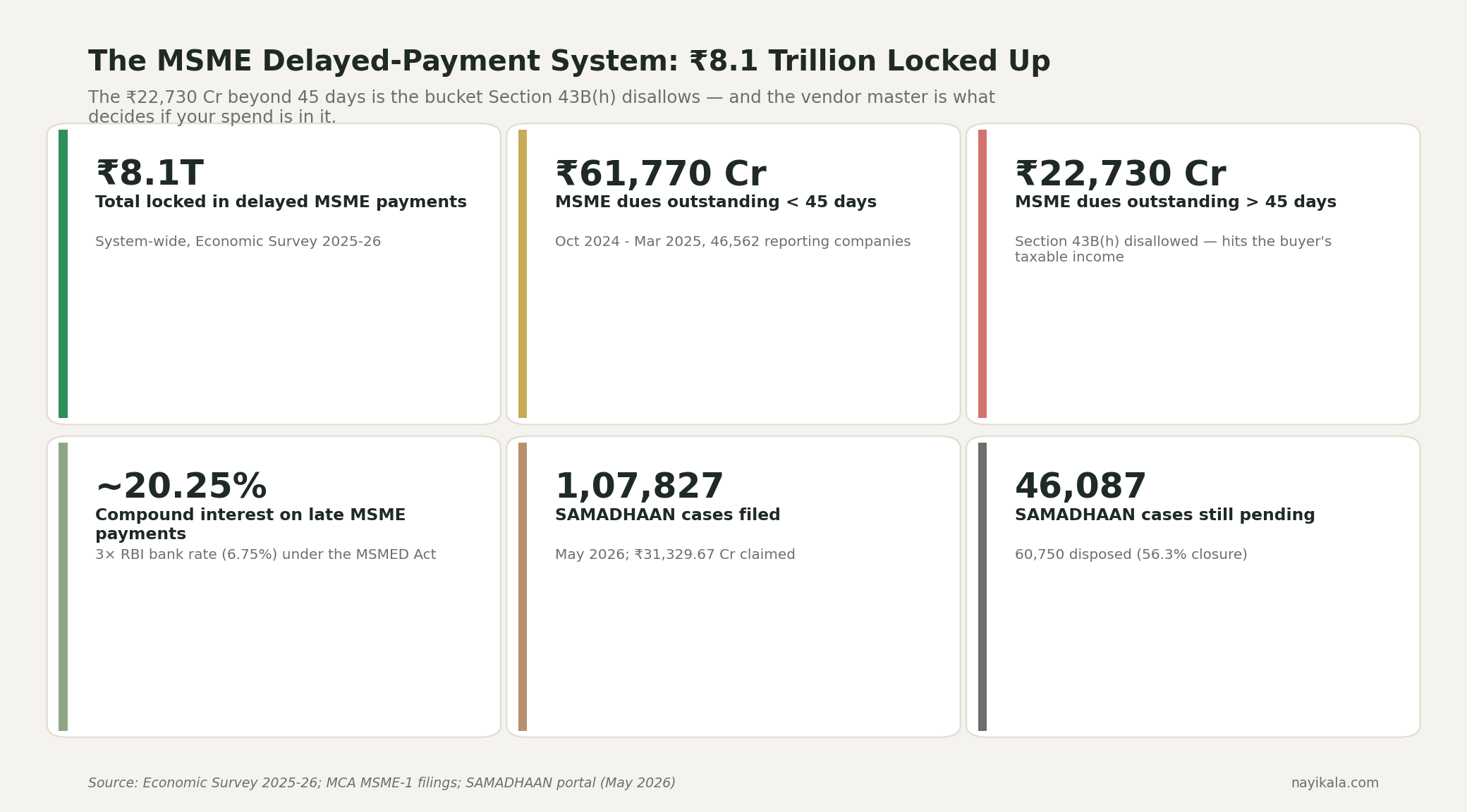
Section 43B(h) of the Income Tax Act disallows your expense entirely if you pay an MSME (Micro or Small only — not Medium) more than 45 days late on a written agreement, or 15 days without one. It also adds compound interest at three times the RBI bank rate — roughly 20.25% per year at the current 6.75% bank rate (ClearTax Section 43B(h) explainer, cleartax.in/s/section-43bh-of-income-tax-act). MSME-1 filings for the Oct 2024-Mar 2025 half showed ₹22,730 crore stuck beyond 45 days across just 46,562 reporting companies. Some of that is your spend, and the disallowance is triggered not by your intent but by your inability to prove, at vendor master creation, whether the supplier is Micro, Small, or Medium.
This is what the manual cycle is actually buying you: time you don't have, exceptions you can't audit, and a tax exposure you can't quantify because the vendor master doesn't carry the field. We covered the broader spend-side audit in The Cognizant Memo Is Sitting On Your Vendor Invoice, and the e-invoicing reconciliation downstream in The GST IMS Switch That Just Made Your ITC Conditional. This post is about the front door.
What you can do Monday morning
Before any tool, audit. Pull every vendor onboarded in the last 90 days. For each one, mark four flags in a spreadsheet:
- Was the GSTIN status checked at onboarding, and recorded? (Active / Suspended / Cancelled / Not checked)
- Is there a Udyam URN on file, and is the category resolved as Micro, Small, or Medium?
- Was the bank account verified by penny drop, or copied from a cancelled cheque?
- Was the e-invoicing capability flag captured? (Mandated and capable / mandated and not / not mandated)
You will discover, on average, that one of these four is missing for more than half your vendor master. That gap is your Section 43B(h) and Rule 36(4) exposure — quantified in an afternoon, free.
Second, fix one input bottleneck. Replace your vendor onboarding email-PDF cycle with a single self-service form. Google Forms, Typeform, n8n's Form Trigger — anything. Capture PAN, GSTIN, Udyam URN, IFSC + account number, and a single PDF upload for cancelled cheque + Udyam cert. The vendor fills it once, on their time. You stop chasing.
Third, manually verify GSTIN through the public GSTN portal for the next ten vendors. The portal returns a field called einvoiceStatus with value "Yes" or "No" — that single field tells you whether the vendor is required to generate an IRN before invoicing you. Most Indian SMEs we've seen don't capture it because their accounts team doesn't know it exists in the response. It's free to look up. It's load-bearing for your ITC.
These three steps cost zero rupees, take a week, and will make the next conversation about automation an informed one rather than an aspirational one.
The pipe — what the build actually looks like
When the manual fix runs out, the architecture is not exotic. It's an n8n workflow on a ₹600-1,000/month VPS with Postgres as the backing store. We run ours on a Hetzner CX22 (~₹340/month, ~50ms from Mumbai), but Mumbai-region HostGator (₹599) or MilesWeb (₹730) work fine if you need INR billing and a GST invoice (TechPlained VPS comparison, techplained.com/cheapest-vps-india).
The workflow:
Form Trigger at /form/vendor-register
  → HTTP Request (GSTIN search via GSP — Adaequare ₹15K/yr or GSTINCheck ₹0.60-0.80/call)
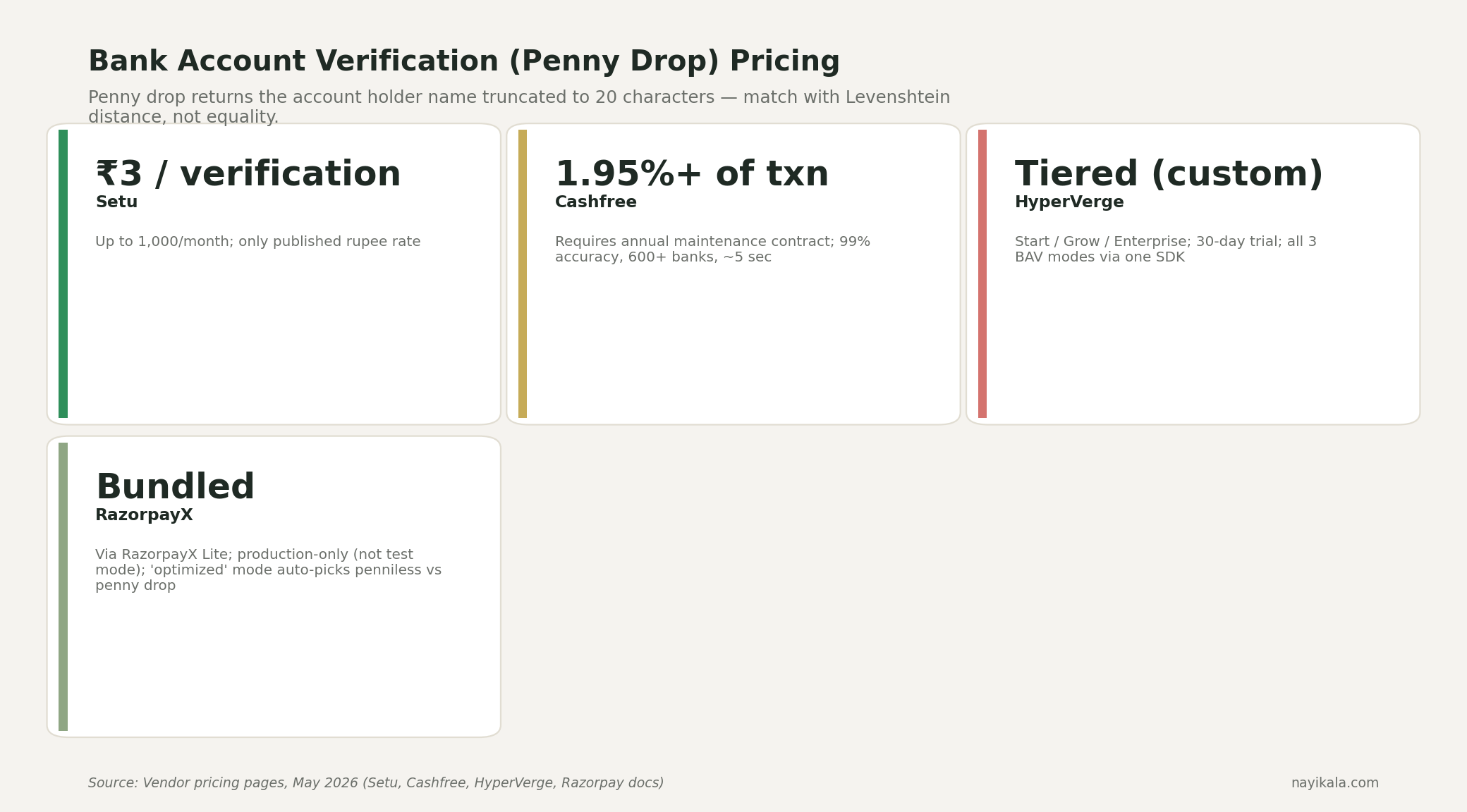
  → HTTP Request (PAN verification via Setu, ₹3/successful call)
  → HTTP Request (Udyam check via AuthBridge or Deepvue)
  → HTTP Request (Bank penny drop via RazorpayX /fund_accounts/validations)
  → Code node (decisioning rules)
  → If node (auto_approve / manual_review)
      [auto_approve] → Postgres INSERT vendor_master
                    → HTTP Request (Tally XML to localhost:9000)
                       OR Zoho Books POST /contacts
                    → Zoho Sign dispatch MSA
                    → Webhook listener for document_completed
      [manual_review] → Email to finance head with one-click resume URL
                     → Wait node (On Webhook Call)
                     → Resume on approval
The decisioning Code node is the part most teams get wrong. The Razorpay merchant onboarding pattern is the one to steal: rules engine, not ML. Pseudo-code:
auto_approve IF (
  gstin_status === 'Active'
  AND pan_matches_gstin_embedded_pan
  AND penny_drop_name_match >= 0.85
  AND no_206AA_flag
  AND not_in_internal_coi_list
  AND vendor_risk_tier === 'low'
) ELSE manual_review
A few non-obvious details that bite you in production. The GSTIN response includes the embedded PAN at characters 3-12 — verify that against the submitted PAN before passing the row, otherwise you trust the wrong field. The penny drop returns the account holder name truncated to 20 characters, which means "RAMESH KRISHNAMURTHY IYER PVT LTD" comes back as "RAMESH KRISHNAMURTHY" and your exact-match rule rejects a valid account. Use Levenshtein distance ≤3, not equality. Section 206AB was abolished from April 1, 2025 under the new Income Tax Act 2025 (ClearTax TDS changes, cleartax.in/s/tds-and-tcs-changes-from-april-2026). Every vendor master we've opened in the last three months still has the 206AB flag firing as a deduction filter. Strip it out of your rule set, or you'll under-pay vendors with no legal basis.
For Tally, the XML push goes to localhost:9000 over HTTP after enabling F12 → Data Synchronisation. The envelope is verbose but boring:
<ENVELOPE>
  <HEADER><VERSION>1</VERSION><TALLYREQUEST>IMPORT</TALLYREQUEST>
    <TYPE>DATA</TYPE><SUBTYPE>MASTER</SUBTYPE></HEADER>
  <BODY><IMPORTDATA>
    <REQUESTDESC><REPORTNAME>All Masters</REPORTNAME>
      <STATICVARIABLES><SVCURRENTCOMPANY>YourCo</SVCURRENTCOMPANY>
      </STATICVARIABLES></REQUESTDESC>
    <REQUESTDATA><TALLYMESSAGE xmlns:UDF="TallyUDF">
      <LEDGER NAME="Vendor ABC Pvt Ltd" ACTION="Create">
        <PARENT>Sundry Creditors</PARENT>
        <GSTIN>27AAAAA0000A1Z5</GSTIN>
        <GSTREGISTRATIONTYPE>Regular</GSTREGISTRATIONTYPE>
        <STATENAME>Maharashtra</STATENAME>
      </LEDGER>
    </TALLYMESSAGE></REQUESTDATA>
  </IMPORTDATA></BODY>
</ENVELOPE>
Response status 1 means success, 0 means no action taken (usually a duplicate name), -1 means error. If you're on Zoho Books instead, it's a single POST https://www.zohoapis.in/books/v3/contacts?organization_id={org_id} with contact_type: "vendor", gst_treatment, and place_of_contact. Store the returned contact_id against your Postgres vendor_master.zoho_contact_id so the next workflow — invoice intake — has the join key.
What it costs versus what they'd quote you
For an Indian SME running 200-500 vendor onboardings a year, the run-rate math:
- VPS: ₹600-1,000/month
- API verification calls (Setu PAN ₹3, GSTINCheck ₹0.60-0.80, RazorpayX penny drop, Adaequare GSP ₹15K/yr flat): roughly ₹500-1,500/month at this volume
- Total: ~₹15,000-30,000/year
Coupa's small/mid segment lands at $50K-200K/year subscription plus $25K-100K implementation — call it ₹41 lakh to ₹1.6 crore annually, before any India localization which doesn't come native.
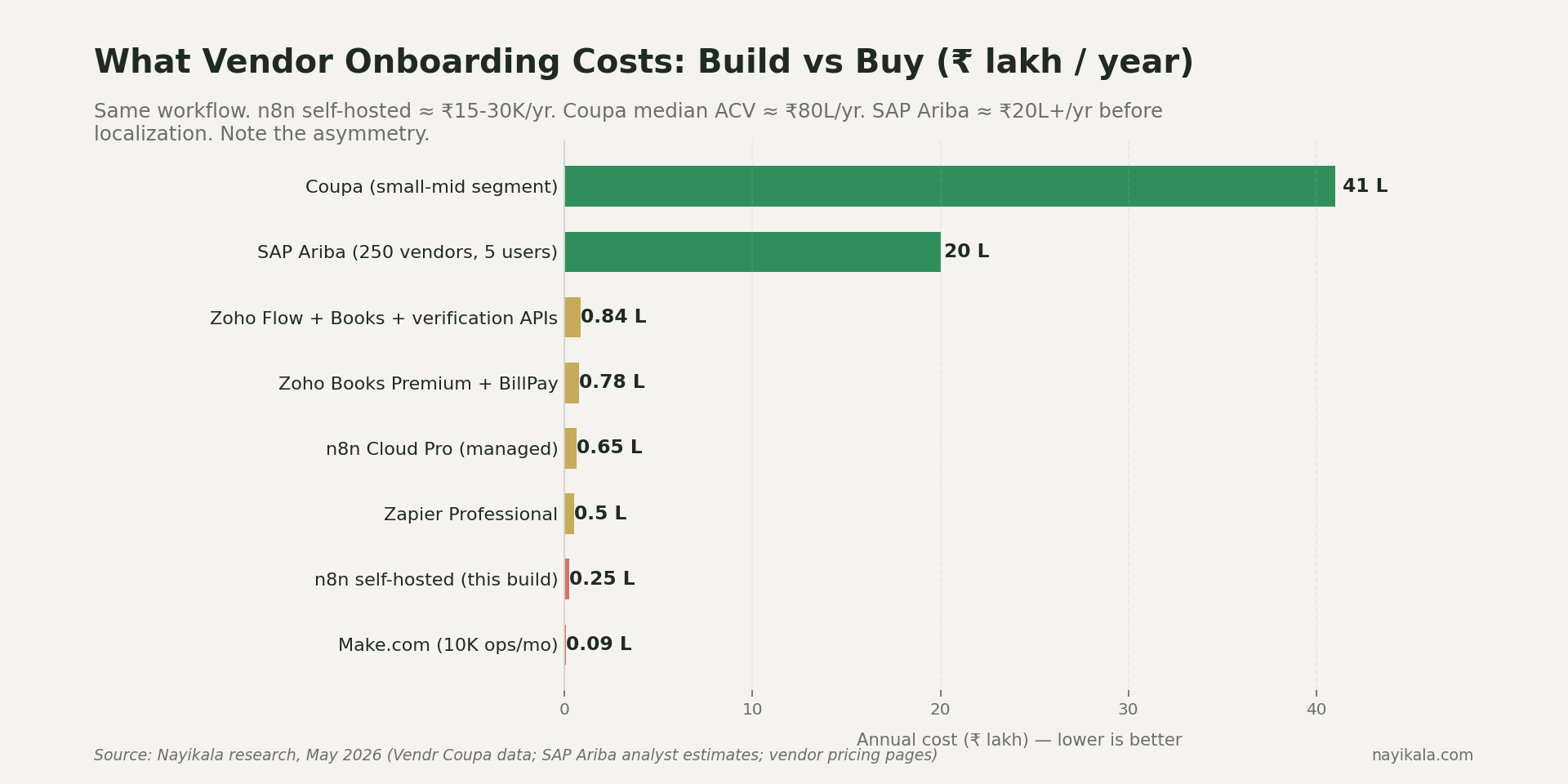 SAP Ariba for 250 vendors and 5 users sits at ₹20 lakh to ₹2 crore+ before the SAP Document & Reporting Compliance add-on and the GSP integration that takes a separate two-week sandbox onboarding.
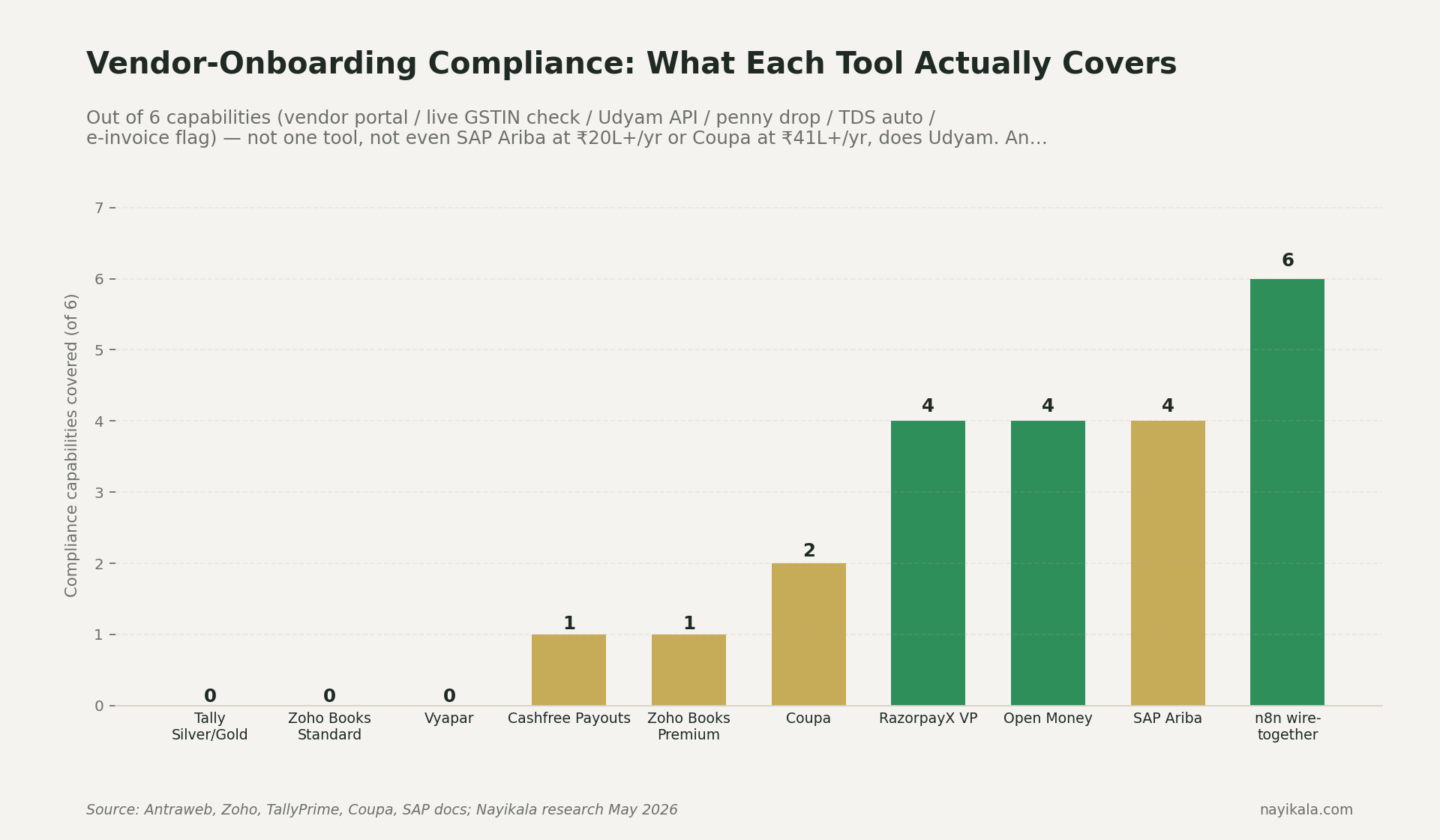
Agentforce Operations at $0.10 per agent action looks cheaper until you remember it's a $125-150/user/month add-on to Salesforce that you don't already have, and the supplier onboarding blueprint emits free-text fields for GSTIN and Udyam because the underlying agent has no India tax registry to call. The only Salesforce-native GST option is a third-party AppExchange plugin called IdentryX from Manras Technologies, which covers Aadhaar, PAN, and GST — and explicitly does not cover Udyam (manras.com/salesforce-gst-kyc-solution). The exact field that triggers Section 43B(h) compliance is the one the integration doesn't fetch.
The compliance teeth — and where n8n fails the audit
The build is the easy part. The compliance wrapper around it is where most self-hosted automations quietly fail.
MCA audit trail has been mandatory since April 1, 2023. Every modification to electronically maintained books needs an edit log — who, when, what — and the feature cannot be disabled, with a minimum eight-year retention (India Briefing audit trail mandate, india-briefing.com). n8n's default workflow execution log prunes after 14 days with a 10K-execution cap. That is not an audit trail. The audit trail must live in your Postgres vendor master with created_at, created_by, and an audit_log table capturing every field change — backed up to immutable storage like S3 with object lock for the full eight years. n8n's history is operational telemetry, not regulatory record.
DPDP Act substantive compliance kicks in May 13, 2027, eighteen months after the November 2025 Rules notification (PIB notification, pib.gov.in/PressReleasePage.aspx?PRID=2190655). Vendor PAN and bank details are personal data linked to identifiable individuals; lawful basis is contractual necessity, but Rule 3 plain-language notice still applies. And Aadhaar — Section 57 of the Aadhaar Act was struck down by Puttaswamy-2 in 2018, which means private companies cannot collect or use Aadhaar for vendor KYC. Use PAN, check the PAN-Aadhaar link status without storing the Aadhaar number. Two of the three ERPs we opened last quarter still have an Aadhaar field on the vendor onboarding form. Remove it.
The engineering landmines you'll hit in production
Three n8n-specific traps worth flagging before you ship.
N8N_ENCRYPTION_KEY defaults to auto-generation on first launch, written to ~/.n8n/config. Rebuild the Docker container without a persistent volume, and n8n silently generates a new key — every credential you've stored becomes cryptographically unrecoverable (GitHub issue #12949). Set the env var explicitly in docker-compose.yml and mount /home/node/.n8n to a host volume on day one.
In March 2026, two CVEs landed at CVSS 9.4: CVE-2026-27495 (JS Task Runner sandbox escape via prototype climbing → host RCE) and CVE-2026-27497 (Merge node SQL query mode RCE via AlaSQL). Both fixed in n8n 1.123.22 / 2.9.3 / 2.10.1. Either one chained with credential DB access decrypts every secret you've stored — including your GSP token, your RazorpayX key, your Zoho refresh token. Patch is non-negotiable.
The Postgres Trigger node has two open reliability issues — #17795 (LISTEN sessions don't terminate on workflow toggle, exhausts connections) and #13646 (silently stops listening, no log error). Don't use it as your primary driver. Use Form Trigger + HTTP Request chain. Postgres is reliable as a target. It is not yet reliable as a source.
For Tally specifically, every failure mode is operational rather than architectural: the desktop must be running, a company must be loaded, the license server must be reachable (otherwise Educational Mode blocks imports), and the HTTP connector cannot handle concurrent writes — race conditions on parallel n8n flows will silently overwrite. We queue Tally writes serially, retry with exponential backoff, and surface the failure to a dedicated Slack channel rather than the main ops channel. Half the operational maturity of this pipe is in how you handle the Monday morning where Tally hasn't been opened yet.
The Udyam scraper trap
Here is the part we don't have a clean answer to.
There is no government API for Udyam verification. The portal at udyamregistration.gov.in/Udyam_Verify.aspx requires CAPTCHA. Every commercial provider — AuthBridge, Deepvue, Perfios, Signzy, Figment, Gridlines, Attestr — is a scraper wrapper or a partner-routed scrape. The Ministry of MSME has historically added CAPTCHA layers, and when they do, every provider's API breaks within hours of each other. Your vendor onboarding pipe goes blind, and with it your Section 43B(h) compliance tracking — the very thing that determines whether your expense is deductible.
You can engineer around it: PDF upload + OCR fallback, 30-day TTL cache on Udyam status, parallel calls to two or three providers and accept the first success. None of this is a real solution. The real fix is a government API the government has shown no signs of building.
Adjacent to it sits authorized signatory verification. The APIs return who is registered with GSTN or MCA. They do not tell you whether the person currently signing your MSA is currently authorized to bind the entity. That's a board-resolution-and-PoA problem; the ground truth requires either a paid MCA director-status feed with quarterly refresh, or a manual review you'll skip on the third vendor.
The real design decision is what your pipe does in the eight hours between when MSME adds a CAPTCHA and when every Udyam API in the country comes back online — because Section 43B(h) doesn't pause for that.
Related reading
← All posts