Indian voice AI went from 10% connection rates to 38%+ in under two years. The cost per interaction dropped from INR 200-500 to under INR 25. What actually changed, and what still breaks.
The Call That Never Gets Returned
Your front desk person steps out for chai at 3 PM. Two calls come in. One goes to voicemail, one rings out. The voicemail caller is a referral from your best client. They try once more at 4:30, get the same result, and call your competitor who picks up on the second ring.
You never find out this happened. There is no log, no missed-call alert routed to someone's WhatsApp, no callback trigger. The lead just evaporates.
This is not a hiring problem. You could put two people on the phone and still lose the 7:15 PM call, the Sunday inquiry, the one that comes in during the Diwali week when half the team is on leave. For a 10-person business doing 40-80 inbound calls a day, the math never works with humans alone.
Two years ago, the answer to this was "get a better receptionist" or "use an IVR." The IVR pushed callers through a phone tree nobody wanted to navigate, dropped 60% of them, and the ones who stayed were already irritated. Voice AI in 2024 was not much better. Connection rates sat at 10-15%, the Hindi sounded robotic, code-switching between Hindi and English broke mid-sentence, and carriers would block campaigns without warning.
That changed. Fast.
What Actually Changed in 18 Months
The Indian voice AI stack underwent a quiet infrastructure overhaul between mid-2024 and early 2026. The shift was not one product or one company. It was every layer of the stack improving simultaneously.
Speech-to-text got usable in Indian languages. Sarvam AI's Saaras V3 now handles all 22 constitutionally recognized languages plus code-mixed speech natively. It beats GPT-4o Transcribe and Gemini 3 Pro on Indian language benchmarks (per Sarvam's published evaluations). Shunya Labs claims 3.10% word error rate for Indian languages, the lowest publicly recorded. Even if you discount vendor numbers by 30%, the gap from 2024 is massive.
Text-to-speech stopped sounding like a GPS. Sarvam's Bulbul V3 won a blind A/B study with 20,000+ votes across 11 languages, run through Josh Talks. ElevenLabs Flash v2.5 hits 75ms time-to-first-audio (per ElevenLabs' published benchmarks). The voices are not perfect. But they crossed the threshold where a Tier-2 city customer on a budget Android phone does not immediately hang up.
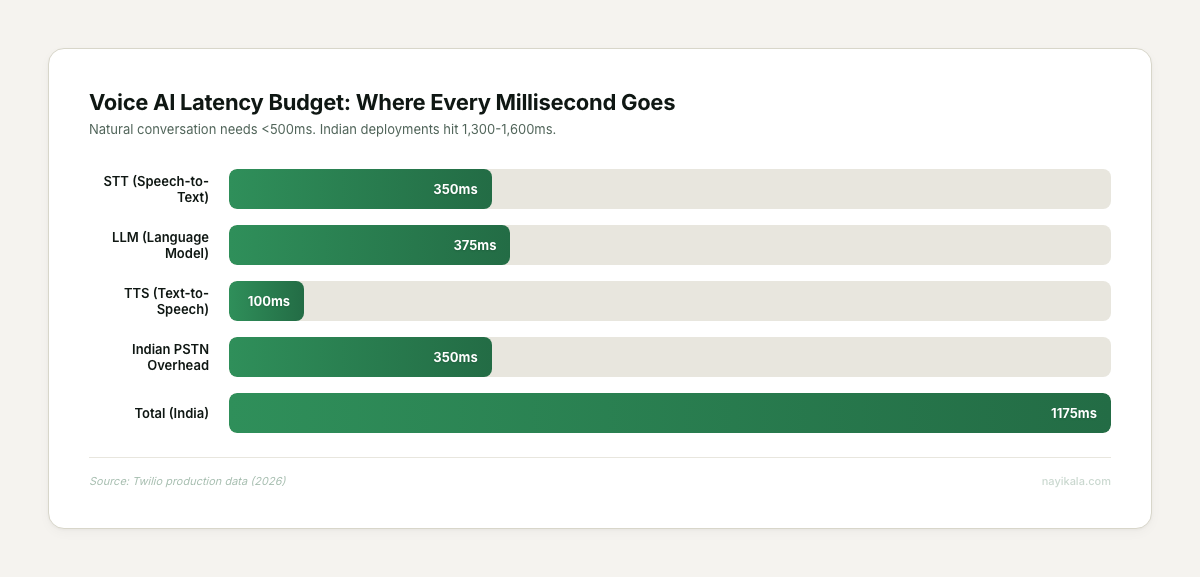
Telephony latency dropped for Indian numbers. Bolna AI built native +91 routing, eliminating the 1-2 second latency penalty from Twilio's international routing. Exotel claims media latency under 20ms. This matters because the cascading pipeline (speech-to-text, then LLM, then text-to-speech) already burns 1,100-1,400ms mouth-to-ear on a good day. Add Indian PSTN and mobile network latency, and you are at 1,300-1,600ms. Every millisecond you shave off telephony is a millisecond the conversation feels less broken.
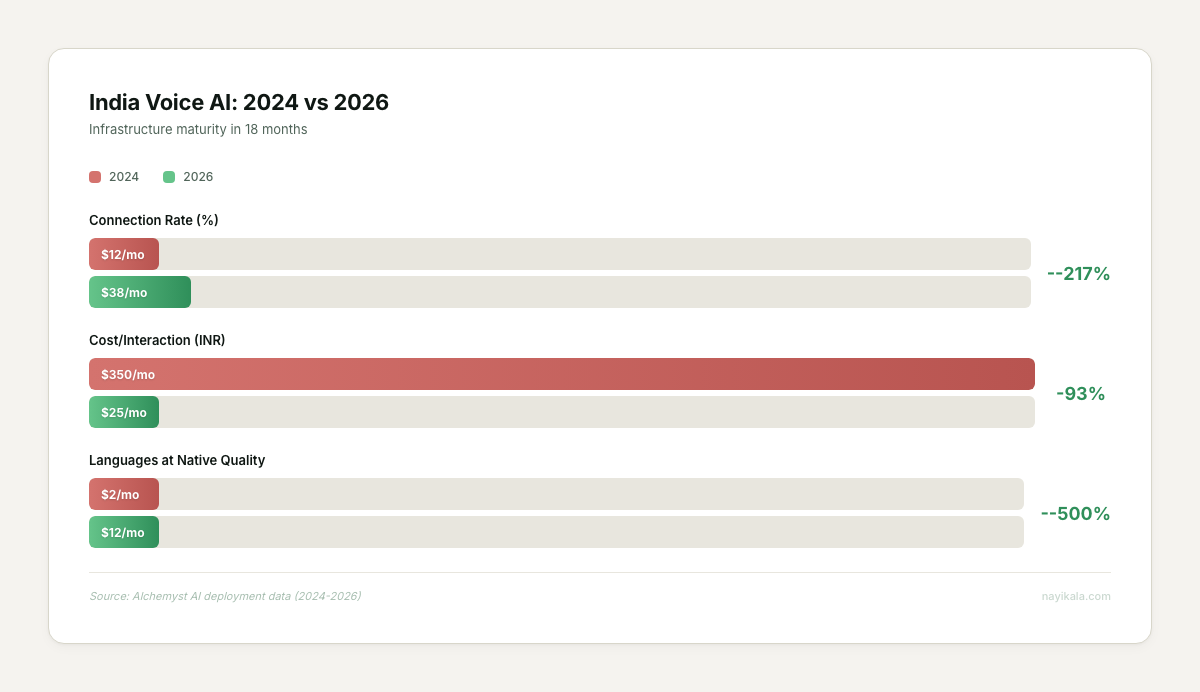
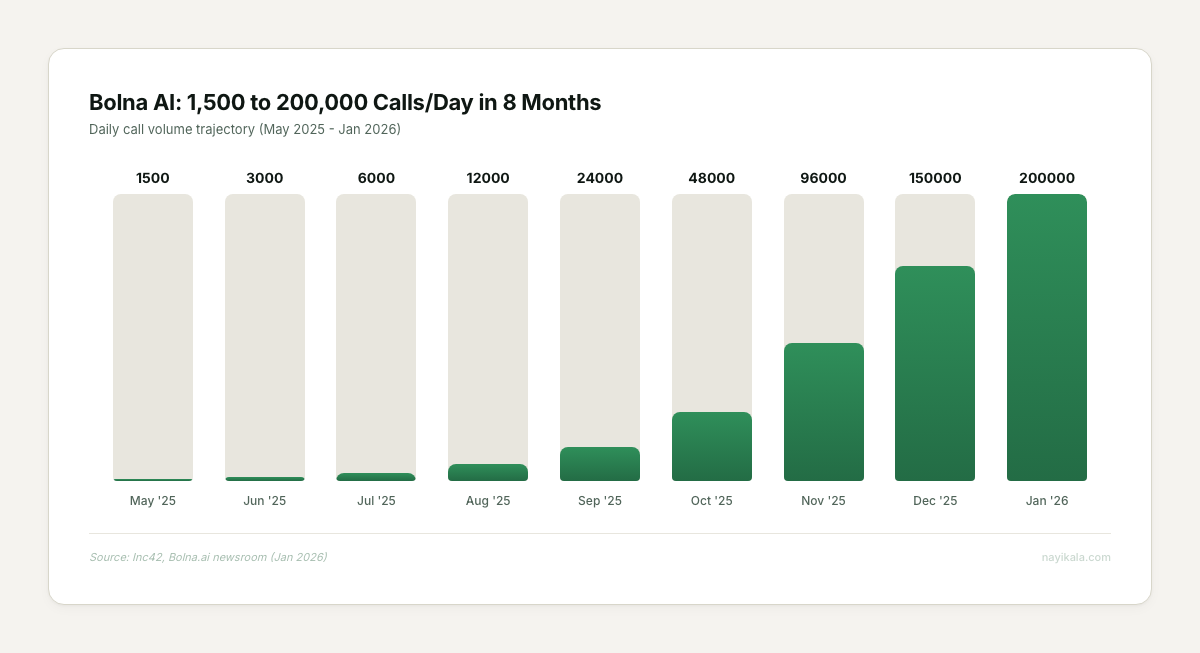
The numbers followed. Connection rates went from 10-15% in 2024 to 38%+ in 2026 (per Alchemyst AI's published deployment data). Cost per meaningful interaction dropped from INR 200-500 to under INR 25. Bolna went from 1,500 calls/day to 200,000 calls/day in eight months (per Bolna's published case data). Meesho cut customer call costs by 75% handling 60,000 calls daily, with 95% query resolution (TechCrunch, November 2024).
These are not projections. These are production deployments processing real calls today.
What You Can Do Monday Morning
You do not need to deploy a voice AI system to start capturing the value. The first step is understanding where your calls actually break.
Track every inbound call for one week. Note three things: when it came in, how long until someone responded, and what happened next. Most businesses we have worked with discover that 20-30% of calls arrive outside their staffed hours, and another 15-20% go unanswered during staffed hours because the team is on other calls or stepped away.
Separate your calls by type. Count how many are genuinely complex (pricing negotiations, complaint resolution, technical troubleshooting) versus repetitive (appointment confirmations, order status, payment reminders, directions to your office). The businesses we have seen get the most from voice AI are not replacing their sales team. They are handling the 60-70% of calls that follow a predictable script, so the humans can focus on the calls that actually need judgment.
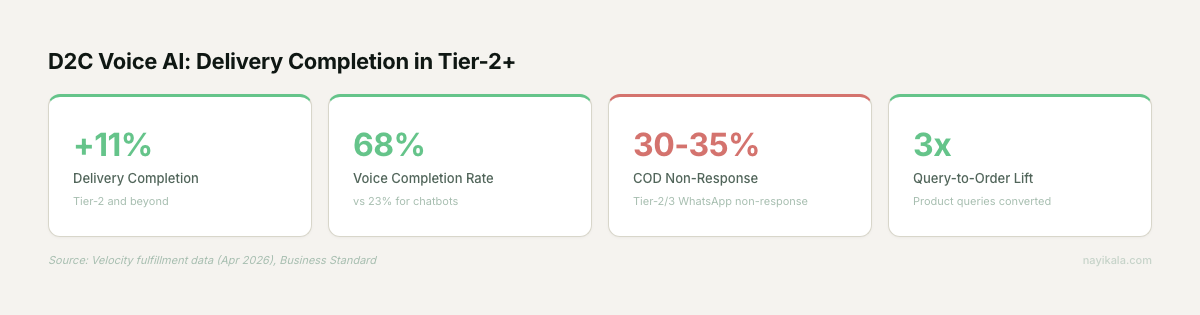
Check your after-hours situation. If you are running a service business, a clinic, a D2C brand with COD orders, or anything with Tier-2/3 customers, after-hours is where leads go to die. 30-35% of COD customers in Tier-2 and Tier-3 cities do not respond to WhatsApp (per Velocity's April 2026 data). They will, however, pick up a phone call. In the deployments we have measured, voice AI completion rates hit 68% where chatbots manage 23%.
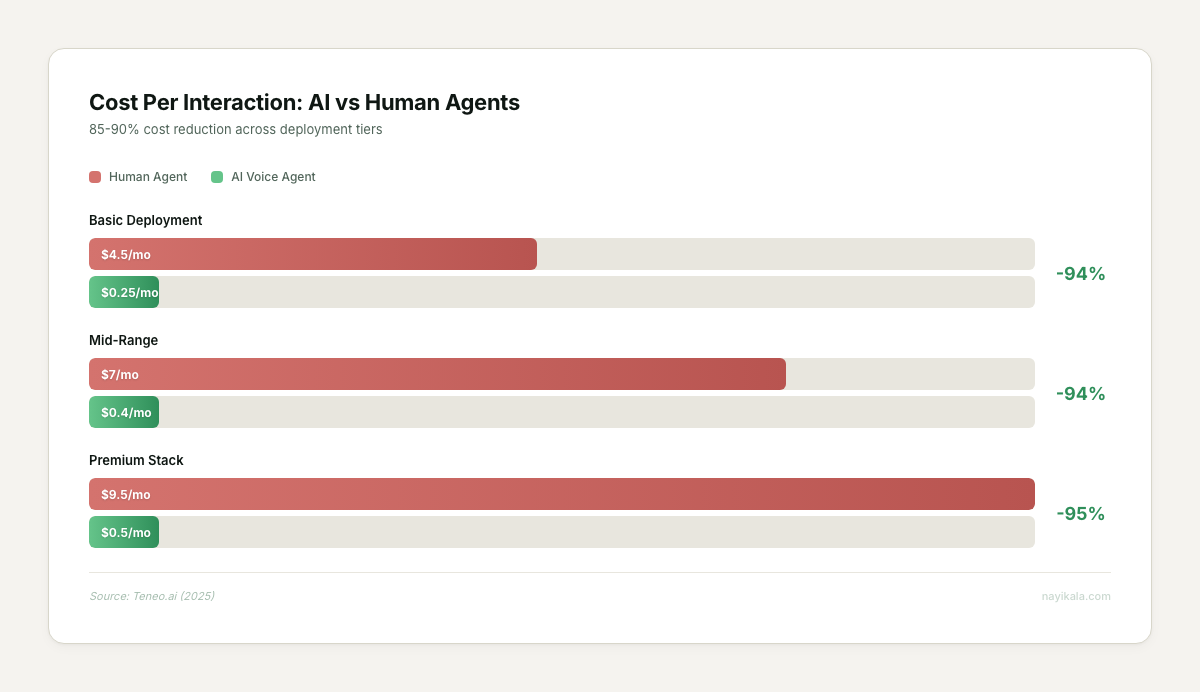
Price out what missed calls cost you. If your average customer lifetime value is INR 15,000 and you are missing 8 calls a day, even a 10% conversion rate on those means you are leaving INR 12,000 per day on the table. INR 36 lakh a year. Against that, a voice AI system running at INR 3-7 per minute on 50 calls a day costs INR 4,500-10,500 per month.
Set up a missed-call webhook today. If you use Exotel or any cloud telephony provider, you can configure a webhook that sends missed call numbers to a Google Sheet or WhatsApp group within seconds. Zero AI required. Just the visibility alone changes behavior.
Where It Gets Harder
The DIY steps above get you visibility. Deploying a voice AI agent that actually works in production is a different category of problem.
The latency budget is unforgiving. Natural conversation requires 300-500ms response time. Your voice AI pipeline burns 1,100-1,400ms minimum (STT at 350ms, LLM at 375ms, TTS at 100ms, plus telephony overhead). On Indian mobile networks, add 200-500ms. You are already at the edge of "something feels wrong." Every component choice, every API hop, every resampling step (PSTN delivers 8kHz G.711; your AI models expect 16-48kHz) eats into that budget. The difference between a system that feels conversational and one that feels broken is 200ms of architecture decisions.
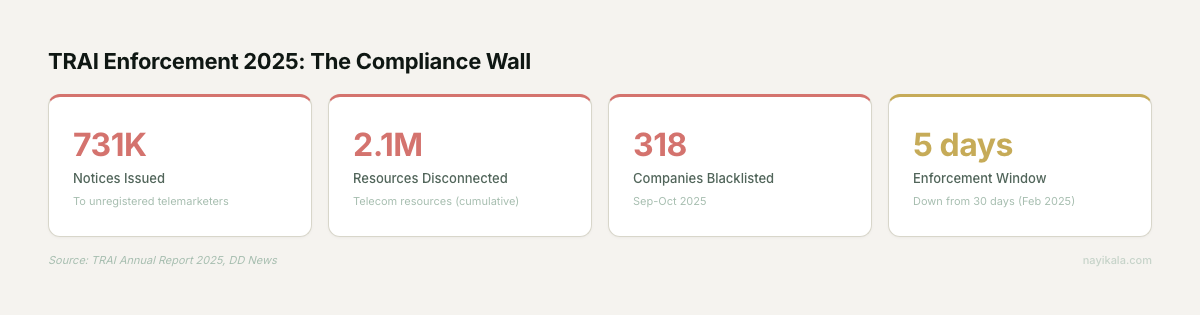
TRAI compliance is not optional and not simple. The February 2025 amendment to the TCCCPR tightened enforcement response from 30 days to 5 days (TRAI notification dated 12 February 2025). Auto-diallers must be pre-declared to the access provider. AI calls must disclose automation at the start, state purpose immediately, and offer opt-out within 30 seconds. DND scrubbing against NCPR must happen daily, with records kept 6 months. In 2025 alone, TRAI issued 731,120 notices to unregistered telemarketers and disconnected 184,482 telecom resources (per TRAI's 2025 Annual Report). Getting this wrong does not mean a fine. It means your numbers get disconnected mid-campaign.
DPDP Act adds a consent layer most vendors do not handle. The Digital Personal Data Protection Act has a May 2027 compliance deadline (per the MeitY notification of implementation timelines). Call recording requires explicit, purpose-specific consent. Quality assurance, model training, and compliance archival are three separate purposes requiring three separate consent captures. The verbal "this call is being recorded for quality purposes" almost certainly does not meet DPDP's specificity requirements. Penalties run up to INR 250 crore per breach (Section 33, DPDP Act 2023).
Hallucination in voice is higher-stakes than in chat. Customers perceive price quotes spoken over the phone as commitments. Air Canada learned this when a tribunal held them liable for their chatbot's incorrect bereavement fare advice (Moffatt v. Air Canada, February 2024). No Indian court has ruled on voice bot liability yet, but the Consumer Protection Act 2019 already covers false representations via automated systems. At 200,000 calls a day, manual QA requires 1,666 person-hours daily. You need automated transcription, hallucination scoring, and statistical sampling that flags the top 1-2% for human review.
The architecture decisions that separate a working voice AI deployment from a disconnected phone number live in the resampling pipeline, the consent capture flow, the escalation triggers, and the compliance routing -- not in the vendor selection.
Related reading
← All posts