AI agents don’t need logins. That breaks the per-seat pricing model that funds most of the software you use. Here’s what to do about it before your vendors figure out how to charge you differently.
The Bill That Stopped Making Sense
You are paying for Zoho CRM seats for people who open it twice a week. You are paying for Freshdesk agent seats for a support team that spends half their time copy-pasting the same five answers. You are paying per-seat for Slack, for project management, for call recording software — and a growing number of those seats are occupied by people whose actual work could be a scheduled API call.
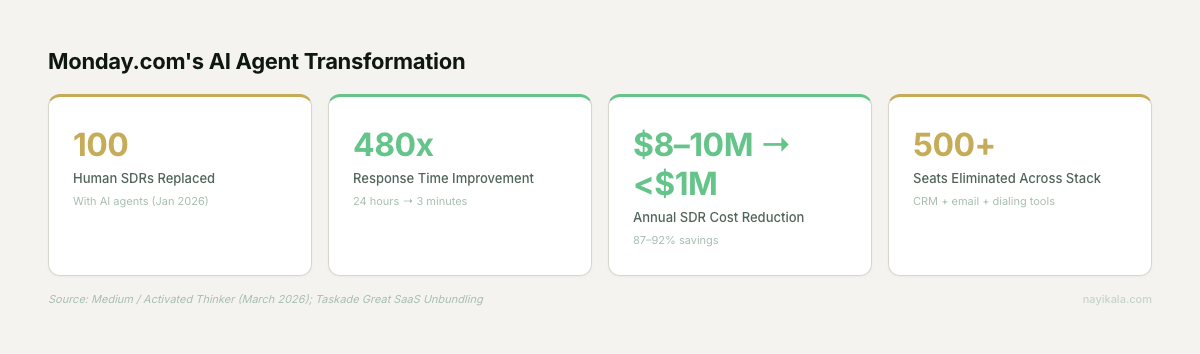
This is not a future scenario. Monday.com replaced their entire 100-person SDR team with AI agents in January 2026 (as reported by SaaStr and confirmed in Monday.com’s Q1 2026 earnings call). Response time went from 24 hours to 3 minutes. The AI does not log into Salesforce through a browser. It writes directly to the API. It does not need an Outreach seat. It calls the email endpoint. Five tools, 100 seats each, reduced to 10 seats total across the stack.
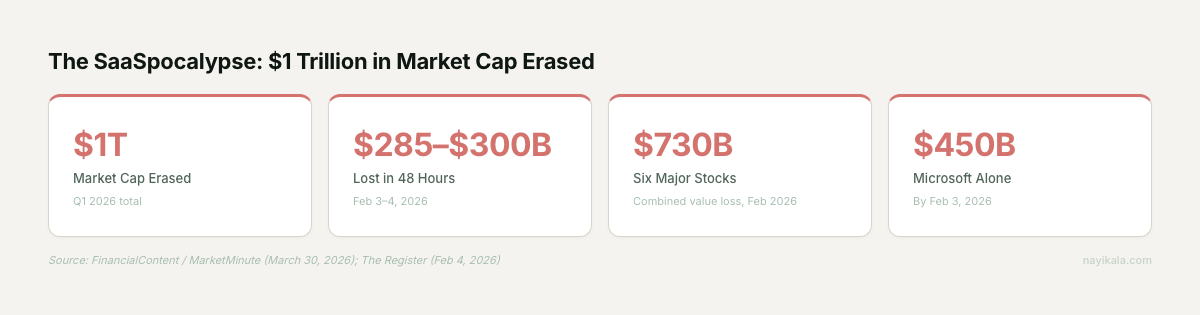
The SaaS companies know this is happening. The iShares Expanded Tech-Software ETF — 114 SaaS stocks — fell 21-25% in Q1 2026 alone (FinancialContent, April 1, 2026). Atlassian reported its first-ever systemic decline in enterprise seat counts. Adobe’s forward P/E collapsed from a 30x five-year average to 12x. The market has a name for it: the SaaSpocalypse.
But here is the thing nobody is explaining clearly to business owners: this is not just a stock market story. This is about what happens to your software bill in the next 18 months.
Why Per-Seat Pricing Is Structurally Broken
The per-seat model works on a simple assumption: one human, one login, one subscription. Revenue scales with headcount. More employees, more seats, more revenue.
AI agents break this at every level.
An agent does not need a GUI. It talks to APIs. One agent can do the work that required five different tool seats across five different platforms. Per MarketMinute’s analysis (March 2026), one AI agent replaces approximately five human software seats — not because it replaces one person, but because it eliminates the entire tool stack that person needed.
Walk through the math for a 100-person SDR function. Each SDR uses Salesforce ($75/month), Outreach ($100/month), LinkedIn Sales Navigator ($100/month), Slack ($12/month), Gong ($100/month), and Zoom ($16/month). That is roughly $403 per seat per month, or $483,600 per year — just for tooling. Replace those 100 SDRs with 20 AI agents managed by 1-2 humans (this is Jason Lemkin’s setup at SaaStr, described in his March 2026 keynote — he calls it “1.2 humans”), and the agents do not need any of those GUI seats. They call APIs directly. LinkedIn Navigator drops from 100 seats to maybe 10 for data access. The rest goes to zero.
This is not a 20% discount. It is a structural collapse in per-seat revenue.
The Valuation Freefall Is the Market Pricing This In
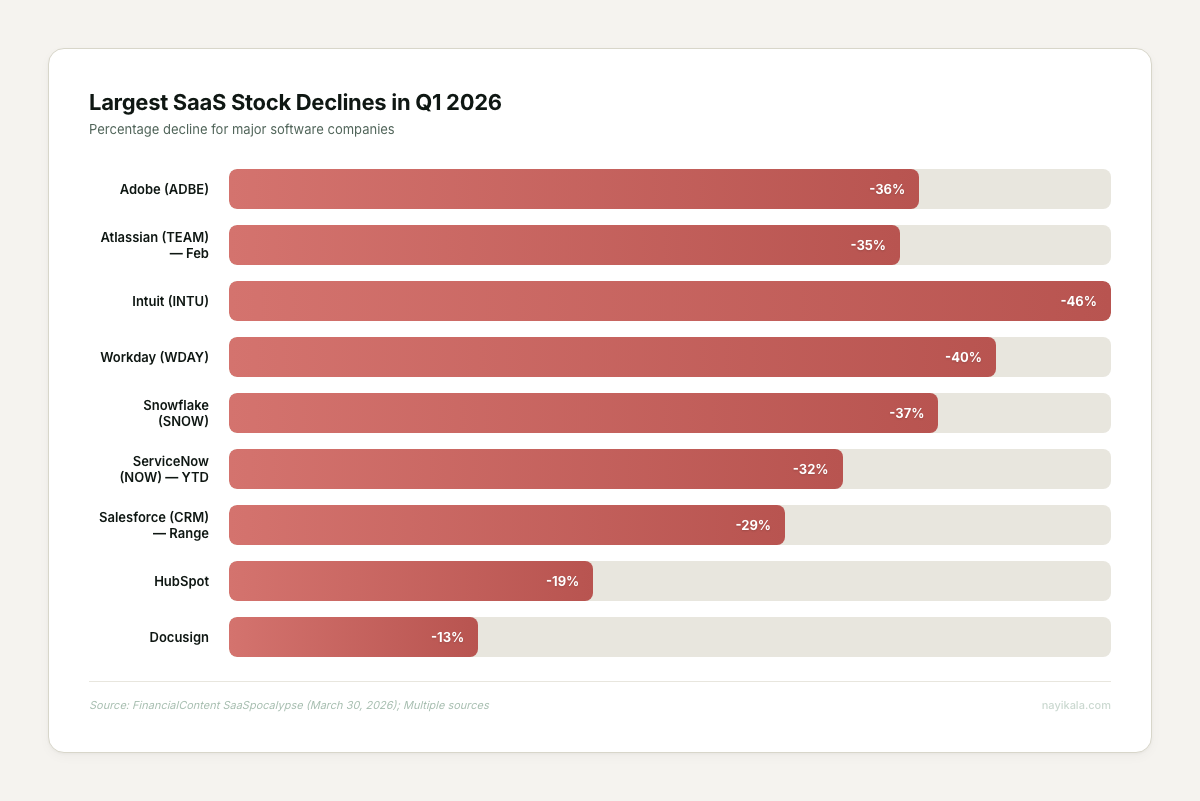
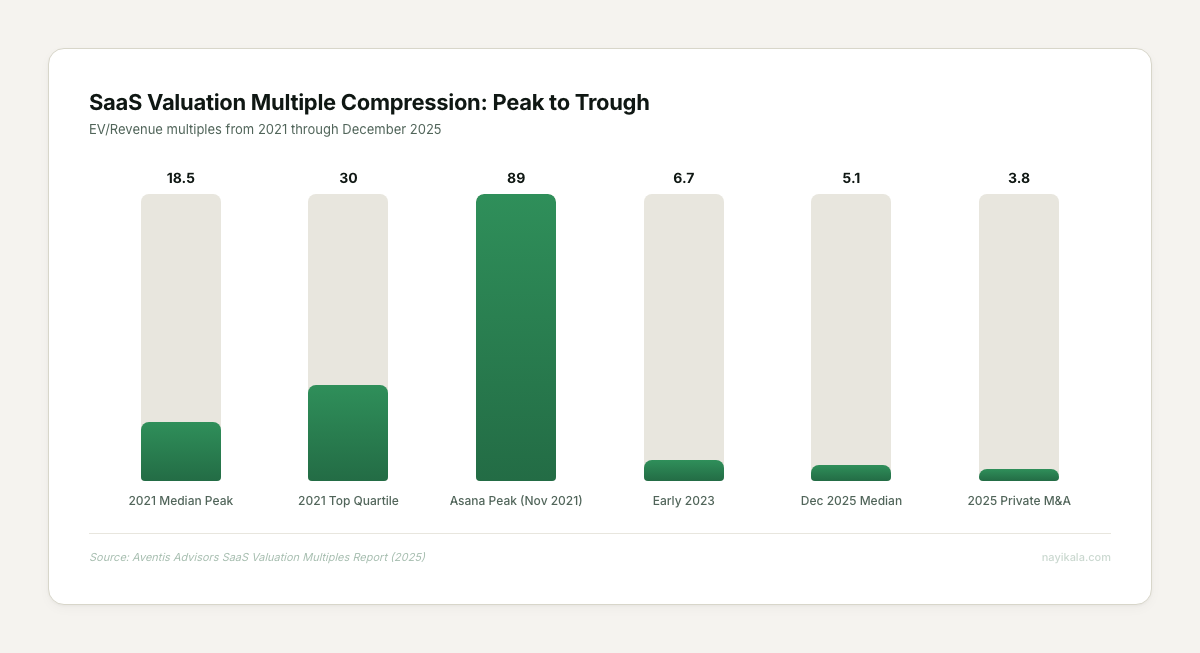
SaaS EV/Revenue multiples went from a median of 18-19x in 2021 to 5.1x by December 2025 (Aventis Advisors). The casualties are specific: Intuit down 46%, Workday down 40%, Snowflake down 37%, Atlassian down 50%+ year-to-date (FinancialContent, April 2026). Monday.com went from $450 to $72.
Salesforce shipped three different pricing models in 18 months for Agentforce: $2 per conversation, then $0.10 per action via Flex Credits, then back to per-user licenses at $125/month. All three are live simultaneously. HubSpot layered a credit system on top of seats — 100 credits per AI conversation, 10 credits per workflow action. The vendors are experimenting in production. That experimentation period is your window.
What You Can Do This Week
Map Your Seat Waste
Before anything else: count your seats. Not your subscriptions — your seats. Pull up every SaaS tool your team uses. For each one, check how many seats are active versus how many are actually used daily.
In the audits we have run for clients, 30-40% of paid seats show fewer than five logins per month. That is money sitting on the table before any AI enters the picture.
Know What Compresses and What Does Not
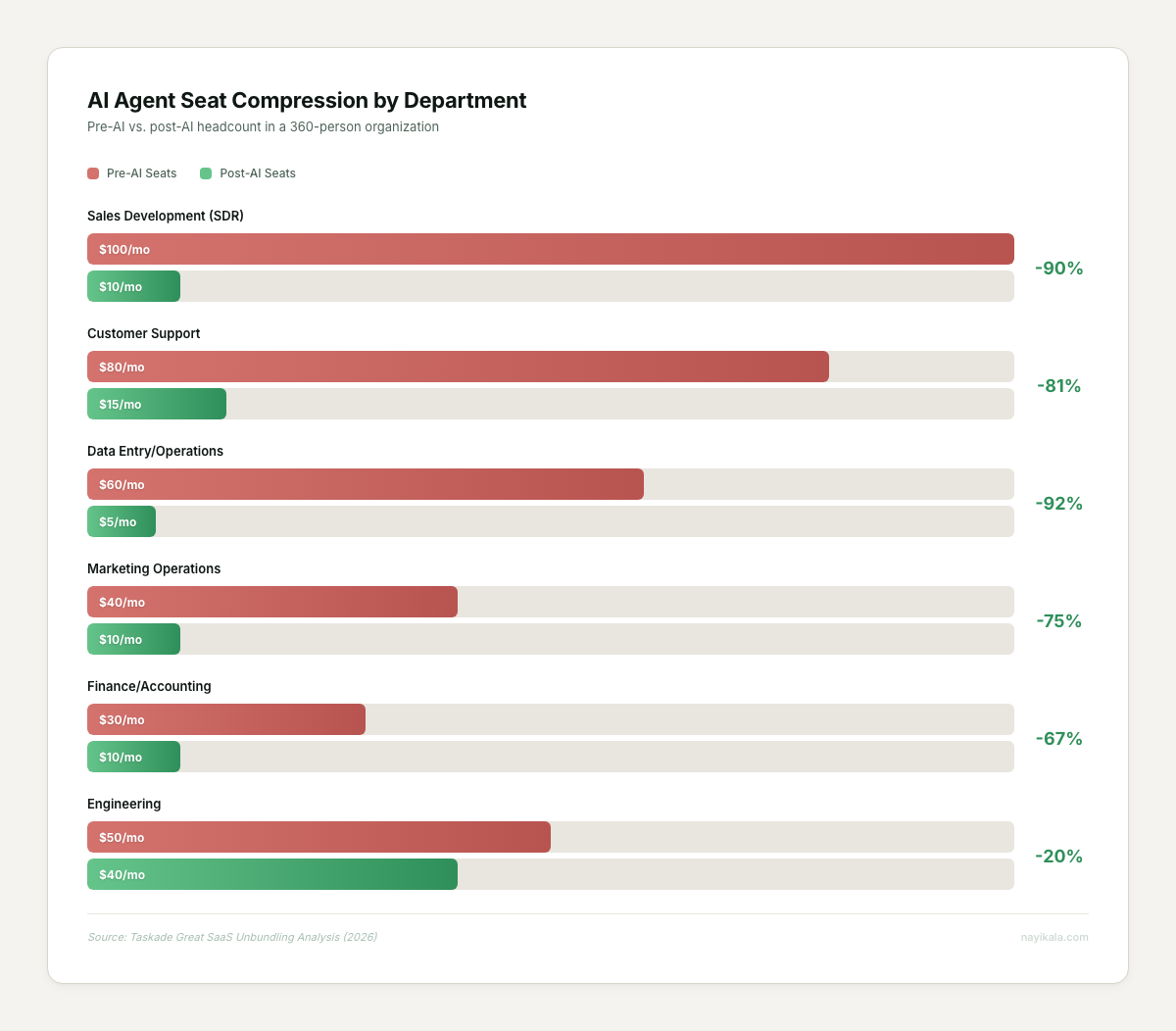
Not every function compresses equally. Taskade published post-AI seat count data in 2026, and the numbers track closely with what we have measured across our own deployments:
- Sales Development (SDR): 90% seat compression
- Customer Support (Tier 1): 81% compression
- Data Entry / Operations: 92% compression
- Marketing Operations: 75% compression
- Finance / Accounting: 67% compression
- Engineering: 20% compression
The pattern is clear. Rule-based, high-volume, low-judgment tasks compress hard. Anything involving complex judgment, regulatory compliance, or relationship management compresses slowly or not at all.
Run the India-Specific Cost Comparison
If you are running Zoho Desk at Rs 1,400/month per agent with 10 support agents, that is Rs 14,000/month for handling Tier 1 tickets. Freshworks’ Freddy AI Agent handles the same volume for roughly Rs 750/month at 7,500 sessions (first 500 sessions free on Growth plans, then $100 per 1,000 sessions). That is a 95% reduction on Tier 1 support costs.
For lead qualification: your SDR costs roughly Rs 5 lakh/year fully loaded. An AI SDR platform runs Rs 8,000-40,000/month and responds in 3 minutes instead of 24 hours. Monday.com reported that connection rates, conversion rates, and booking rates all improved post-switch (Q1 2026 earnings).
For WhatsApp — which is where your customers actually are — AI agents can handle 60-80% of conversations within the free 24-hour service window at zero per-message cost. The marketing template messages cost Rs 1.09 each. The utility messages cost Rs 0.145. In the WhatsApp support flows we have built, an agent that resolves queries within the service window before a template gets triggered is pure margin.
Start With One Workflow, Not a Platform
Do not buy a platform. Pick your single highest-volume, lowest-judgment workflow. For the Indian SMEs we have built these for, it is usually one of these:
- The GST export loop — accountant exports from Tally, pastes into Excel, recalculates, re-imports. An agent with TallyPrime 7.0’s API eliminates the middle steps entirely.
- The Friday report — operations manager compiles numbers from three dashboards. An agent monitors all three and pushes a WhatsApp summary at 5 PM. No Slack seat, no dashboard seat needed.
- Tier 1 support tickets — the same five questions answered 200 times a month.
Build the agent for that one workflow. Measure the output for 30 days. Then decide whether to expand.
Where It Gets Harder
Here is where the ActionAgents pitch and the Monday.com success story stop being the whole picture.
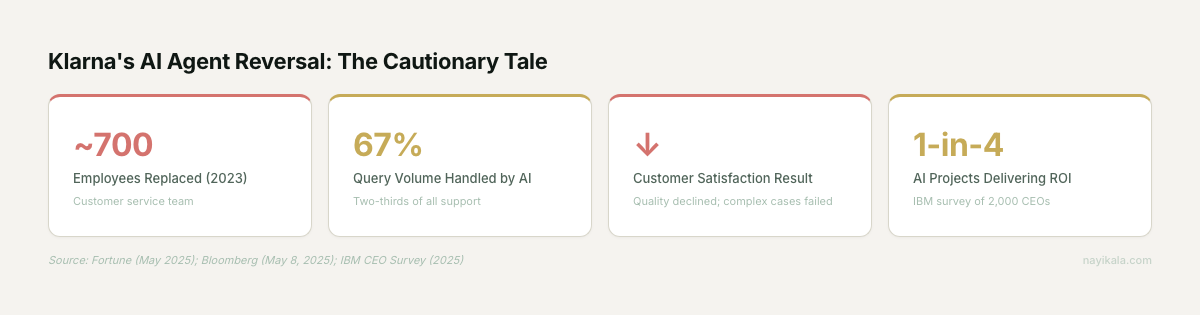
Klarna replaced 700 customer service employees with AI in 2023. Celebrated it publicly. By mid-2025, they were rehiring humans. Customer satisfaction dropped. CEO Sebastian Siemiatkowski admitted: “We focused too much on efficiency and cost. The result was lower quality, and that’s not sustainable.” An IBM survey of 2,000 CEOs found only 1 in 4 AI projects delivered the promised ROI (reported by Fortune, May 2025). Klarna is now running an Uber-style hybrid — AI for volume, humans for exceptions.
The lesson is not that AI does not work. Every full-replacement deployment we have seen that skipped a hybrid layer broke within six months. Monday.com moved its displaced SDRs to outbound prospecting. They did not fire them. The setups we have built that actually hold up have the human-AI boundary drawn before deployment, not discovered after customer satisfaction craters.
But the harder problem is not even the hybrid design. It is the infrastructure underneath.
When a human logs into your CRM, the identity layer is simple: one user, one session, one audit trail. When an AI agent calls that same CRM’s API at 3 AM — who is the agent? What are its permissions? What data does it have consent to read? Who audited what it did?
India’s DPDP Rules 2025 set a compliance deadline of May 13, 2027 (India Briefing). Penalties run up to Rs 250 crore per violation. Your customers gave consent for their data to be processed by your business — not by an autonomous agent making 10,000 API calls while everyone is asleep. The consent architecture for agent-mediated data processing is legally uncharted. You need purpose-limited processing consent, 72-hour breach notification infrastructure, and a data residency answer for every API call your agent makes. Does it route through US servers? Under DPDP, that matters.
Then there is the lock-in problem nobody talks about. Traditional SaaS lock-in was tool lock-in — painful but survivable. AI agent lock-in is accumulated context lock-in. Every correction your agents learn, every workflow preference they internalize, every customer interaction they remember — that is trapped inside one vendor’s infrastructure. MCP gives agents a way to talk to systems, but it does not give them a shared vocabulary. When your CRM agent tells your invoicing agent “this customer is high-priority,” there is no standard that defines what that means. Switching costs compound with every conversation the agent has.
The seat compression math is real and the arbitrage window is open — but the service account governance, the consent re-architecture, and the agent-to-agent semantic layer are where the actual system design decisions live.
← All posts