
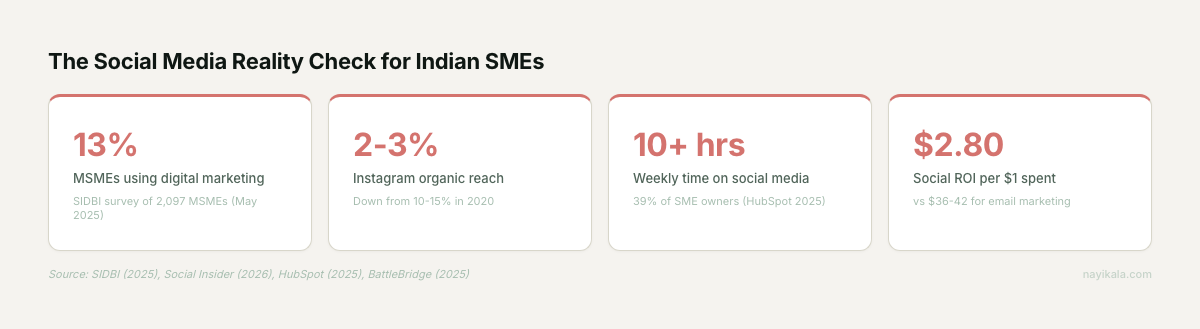
Organic reach on every major platform has collapsed to 1-3%. Indian SMEs spending 10+ hours a week on social media content are operating on economics that stopped working two years ago.
You posted a Reel on Tuesday. It took two hours to shoot, edit, add captions, pick the audio. You checked the insights on Wednesday morning. 247 accounts reached. You have 11,000 followers.
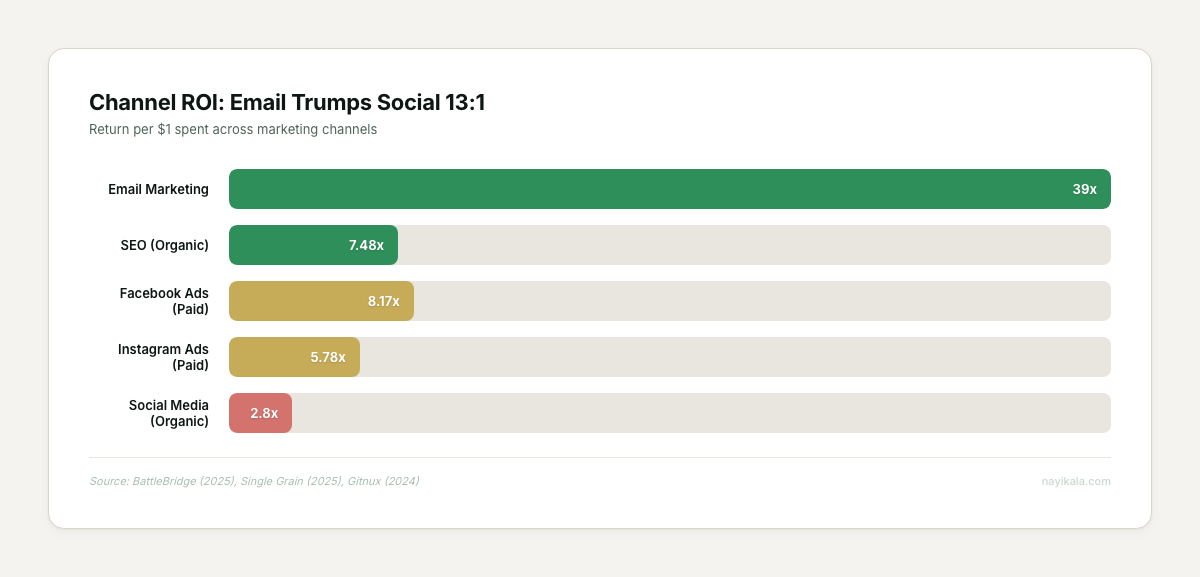
The founders we onboard almost always underestimate how much time they spend on content. That matches what we see in every onboarding — and HubSpot's SMB survey (2025) confirms the broader pattern: 39% of small businesses spend over 10 hours a week. The ROI gap is just as stark. BattleBridge's 2025 comparison puts social at $2.80 per dollar against email's $36-42. That is the real problem. Not the content. The hours.
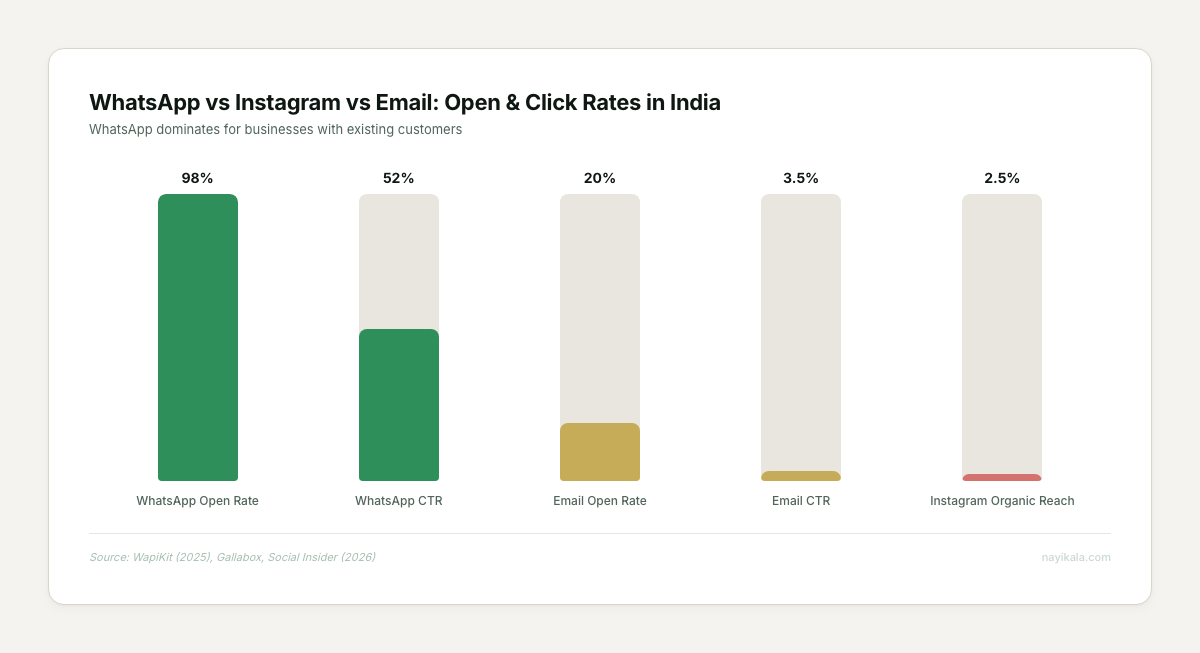
That ratio is not a bug. Every platform we have mapped for clients works exactly this way by design. Instagram's organic reach in 2026 sits at 2-3% of your follower count (Social Insider benchmarks, Q1 2026). Facebook is worse at 1-2%. LinkedIn company pages have lost 60-66% of their organic reach since 2024 (Ordinal, Entrepreneur reporting on LinkedIn algorithm changes).
The business owner in Pune who spent Sunday afternoon batch-creating carousel posts is competing for attention inside a system that has structurally moved to pay-to-play. And the worst part is not the wasted content. It is the wasted time.
The Real Cost Is Not the Content. It Is the Hours.
The businesses we have built systems for all run the same loop. Someone on the team, usually the founder or one operations person who "knows Instagram," becomes the de facto content creator. They shoot product photos, write captions, figure out trending audio, post at the "right time," respond to comments, check analytics. None of this is in their job description. We see it because we map their operations before we build anything.
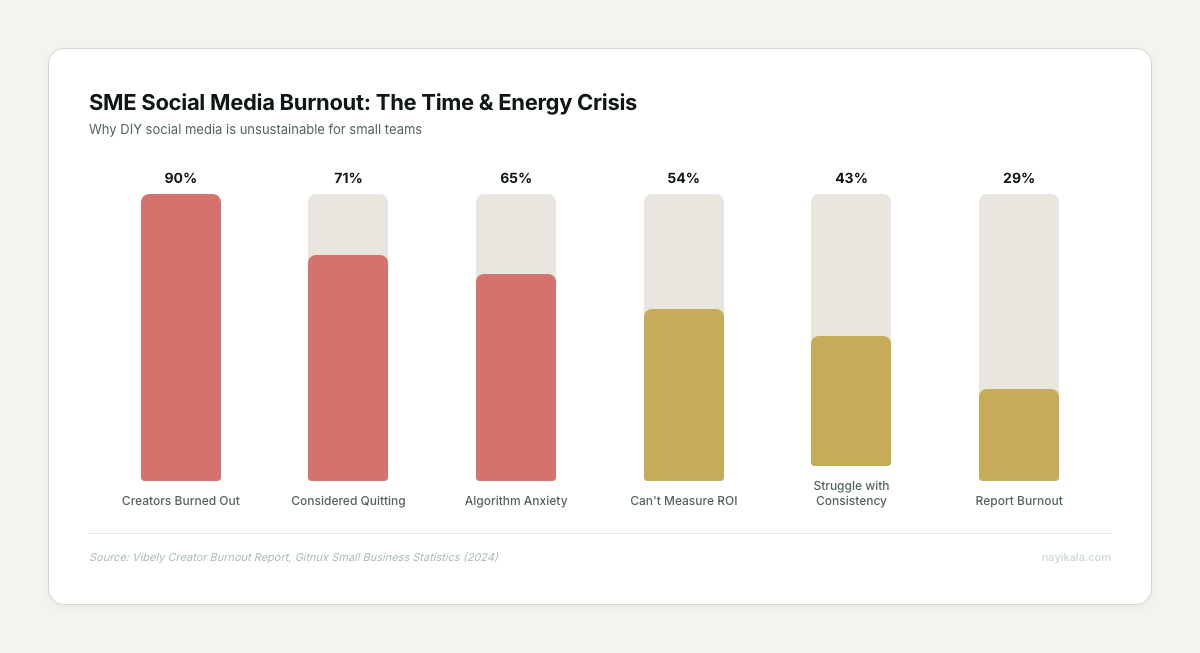
We see the same thing in every onboarding call: the team cannot keep up with consistent content creation, nobody can measure ROI, and the one person who could edit video left three months ago. Every onboarding we run surfaces the same structural mismatch: what the platforms demand versus what a small team can actually produce. Hiring a content freelancer moves the bottleneck — it does not remove it.
The consistency trap makes it worse. The accounts we have built content systems for saw roughly 5x more engagement per post once they hit a consistent cadence — three to four posts per week, same slot, for eight weeks straight. But "consistent" does not mean daily. The founders we have onboarded who dropped from daily posting to 1-2 posts per week saw better per-post engagement. The external data backs this up — Buffer across 100,000+ accounts and ZoomSphere across 25,000+ profiles show the same patterns. The founders grinding out daily content are not just burning time. They are actively hurting their per-post performance.
And then there is the paid math that nobody wants to do. On a 10,000-follower account, organic reach delivers 200-300 impressions per post. At India's average Facebook/Instagram CPM of roughly Rs 150 (SuperAds.ai benchmarks, 2025), you can buy that same reach for Rs 30-45. Three hours of founder time creating a Reel costs far more in opportunity cost than Rs 45 of paid reach.
The economics flipped years ago. The habits have not caught up.
What You Can Do Monday Morning
Stop posting more. Start measuring what you already have.
Track Your Real Numbers
For one week, log every post across every platform. Note the format (Reel, carousel, static image, text post), the time you spent creating it, and the reach it actually achieved. Not impressions. Reach. Unique accounts that saw it.
Most business owners we have onboarded have never done this exercise. When they do, we see the same thing every time: 80% of their content time produces 20% of their reach. Usually one format on one platform dominates, and everything else is noise.
Pick One Platform, One Format
If you are a B2B services company, that platform is LinkedIn and that format is the founder posting from a personal profile. LinkedIn personal profiles get 561% more reach than company pages sharing identical content (LinkedIn's own data, reported by Buffer). Only 2% of LinkedIn users post content. The bar is on the floor.
If you are selling to consumers in a specific region, run one test in the local language. Casagrand switched a portion of their Facebook ads from English to Tamil for Chennai and saw 90% more leads at 60% lower cost per lead (Social Beat case study). Rapido shared 20-30% better ROI from vernacular content in Southern and Western markets at a 2024 industry conference. The vernacular pipelines we have built for two D2C brands in Chennai and Hyderabad show similar numbers — and it tracks when 68% of Indian internet users prefer content in their native language (IAMAI-Nielsen, 2024).
Stop Cross-Posting
Every platform we have tested penalizes content that feels like it was made for somewhere else. LinkedIn deprioritizes external links. Instagram's algorithm weights DM shares and saves, not likes. YouTube measures completion rate and return viewers. A Reel re-uploaded as a YouTube Short with an Instagram watermark is algorithmically dead on arrival.
If you only have bandwidth for two posts a week, make them native to one platform. Two strong, platform-native posts will outperform seven cross-posted ones. Repurposing pipelines that actually work reformat for each platform's signals — aspect ratio, caption structure, CTA placement. Copy-paste is not repurposing.
Run the Founder-Led Content Experiment
Founder-led content consistently outperforms brand accounts. Spinta Digital's study across 50+ Indian founders in wellness, D2C, real estate, SaaS, and education found 5.4% organic CTR on founder posts versus 0.9% CTR on the same companies' brand account ads — with trust among first-time buyers increasing 3x with founder visibility.
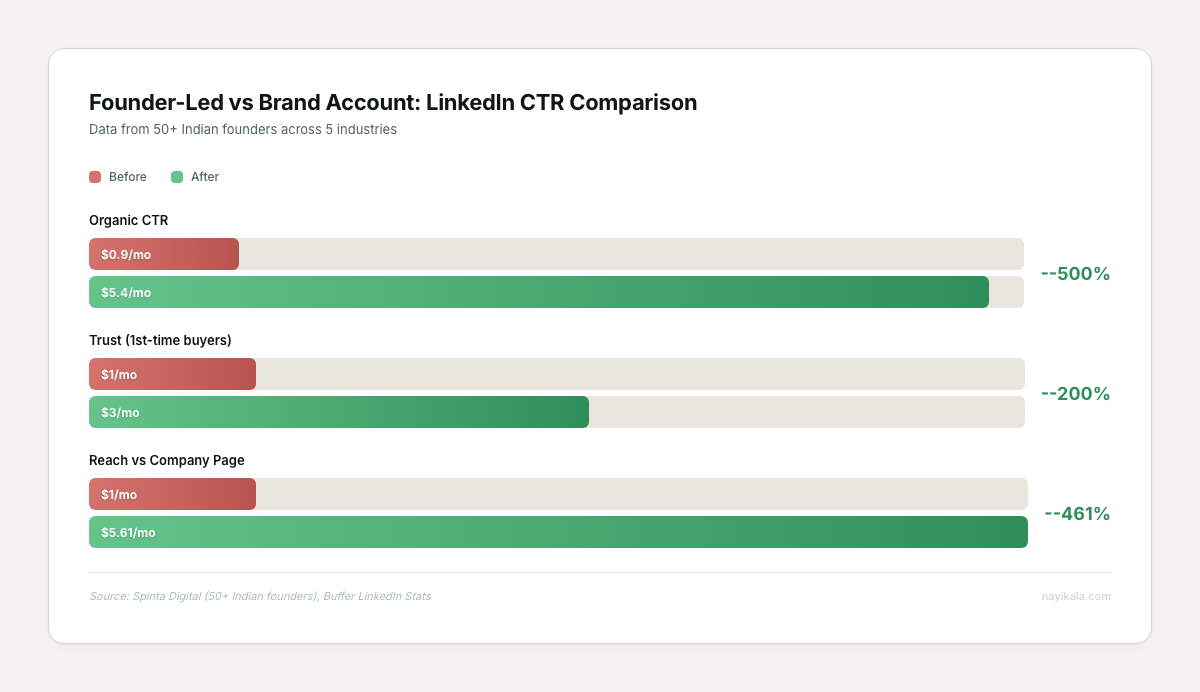
Post one thing from your personal account this week. Not a product announcement. Something about the operational reality of your business. The order that went wrong and how you fixed it. The vendor negotiation that taught you something. We have seen this directly — founders with 800 LinkedIn connections outperforming brand pages with 15,000 followers. Edelman-LinkedIn's 2025 data backs it up: over half of B2B buyers say quality thought leadership makes brand recognition matter less.
Where It Gets Harder
Everything above is free and manual. It will get you from "wasting 10 hours a week on content nobody sees" to "spending 3 hours a week on content that actually reaches people." But the human bottleneck remains. One person still decides what to post, when, in which language, on which platform, and whether any of it converted. That person is usually the founder. And the founder has other things to do.
The first thing that breaks when you try to automate this is repurposing. A single brief should produce a LinkedIn text post, an Instagram carousel, and a Tamil voiceover for the WhatsApp broadcast list. But LinkedIn penalizes external links, Instagram rewards DM shares, and WhatsApp broadcast lists have opt-in requirements that differ by state. The same content, reformatted three ways, now has three different compliance surfaces. This breaks reliably — nobody discovers it until the WhatsApp broadcast gets flagged.
The second thing that breaks is measurement. "Engagement went up this month" is not attribution. A post led to a DM, the DM led to a call, the call led to a pilot — that chain is what matters, and no two businesses define "conversion" at the same point in it. This layer breaks more than any other because every operation arrives with a different version of broken analytics.
The third thing that breaks is the connection between these two. The moment social media inquiries start routing into a CRM, you are building a data pipeline — with retention policies, access controls, and consent logic that fights the attribution logic. Attribution wants to track everything. Consent wants to limit what you store. Inquiry routing wants speed. These three systems have contradictory requirements, and resolving one makes the other two worse.
The hard design decisions live at that junction — where a platform-native post has to connect to inquiry routing, consent capture, and conversion attribution simultaneously.
Related reading
← All posts