
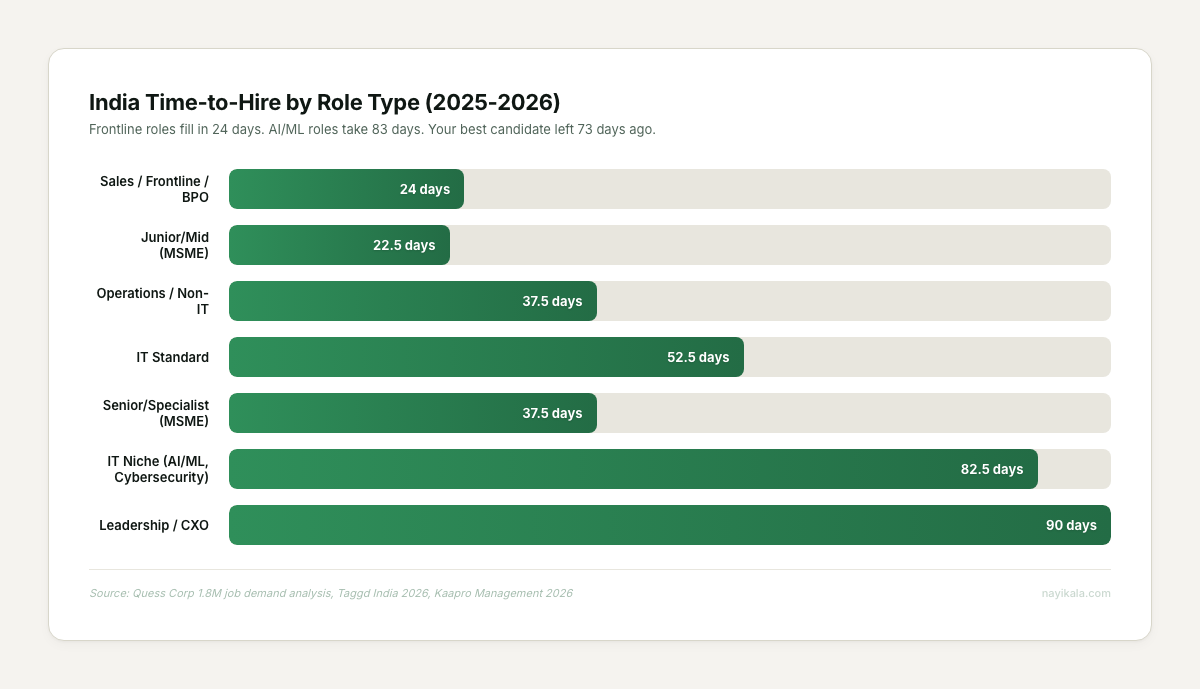
Indian SMEs lose more money to slow hiring than bad hiring. The 47-day gap between posting a role and filling it is a structural problem, not a sourcing one — and most of the fix is process design, not software.
The seat has been empty for three weeks
You posted the job on Naukri twelve days ago. Your ops lead forwarded it to two WhatsApp groups. Someone’s cousin applied, but the resume sat in your Gmail for four days because you were in Surat. By the time you called back, they had already joined somewhere else.
This is not a sourcing problem. You had the candidate. You lost them to time.
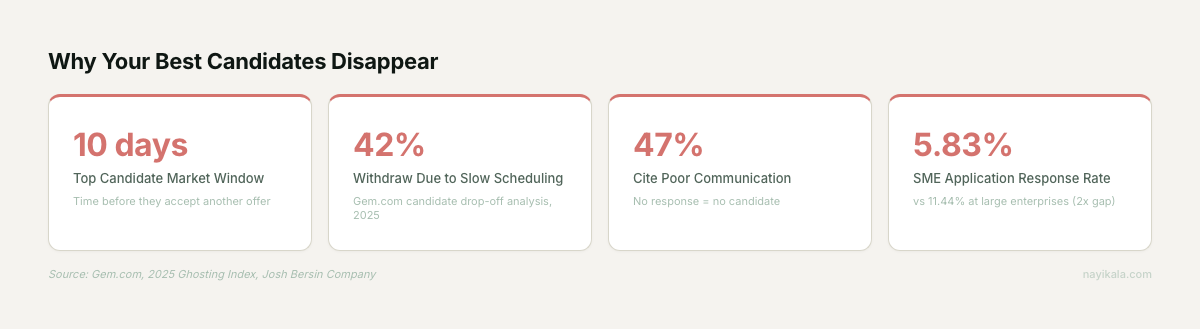
The businesses we work with — 20 to 200 people, hiring five to fifteen roles a quarter — almost never struggle to find applicants. They struggle to move fast enough to close the ones worth closing. The top candidates in India are off the market in 10 days (Gem.com, 2025 recruiter workflow data). The average interview process we have seen takes 23 days. The average time-to-fill for a mid-level operations role in India sits at 30 to 45 days (Kaapro Management, 2026 MSME HR metrics report).
That is not a gap. That is a pipeline design failure. And every day it persists, it costs real money.
The math nobody tracks
Taggd published a detailed hidden-cost analysis of Indian hiring in 2025. The number that should keep founders up at night: Rs 8,295 per day per unfilled seat in lost output. For a 42-day vacancy — which is average — that is Rs 3,48,407 gone before the new hire’s first paycheck clears.
For revenue-generating roles — sales, account management, client delivery — Taggd estimates the monthly vacancy cost at Rs 5.9 lakh to Rs 8.4 lakh.
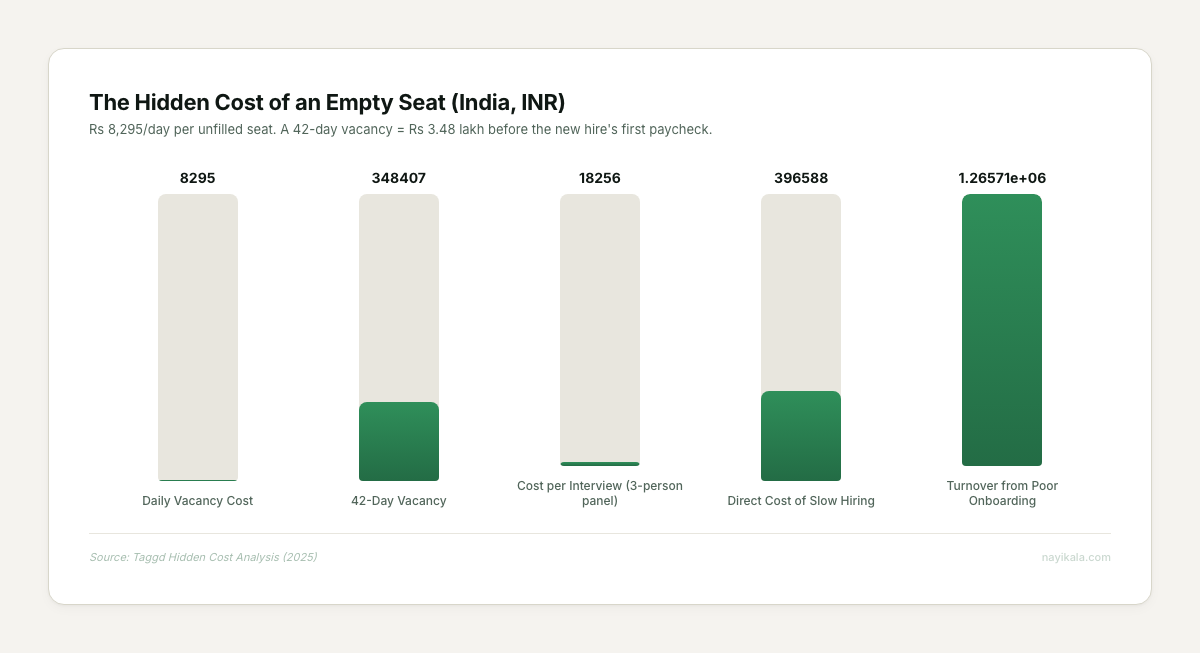
Most SME founders we have spoken to track cost-per-hire. Some track time-to-hire. Almost none track vacancy cost. It does not show up in Tally. It does not appear on the P&L. But it compounds silently — one empty desk in April becomes three in June because the team absorbs the load, burns out, and someone else quits.
Here is where it gets worse. The 2025 Ghosting Index found that small companies (under 50 employees) respond to only 5.83% of applications, compared to 11.44% for large enterprises. That is not malice. That is a founder checking Naukri between client calls and a WhatsApp group where resumes arrive as PDFs named "resume final final v2."
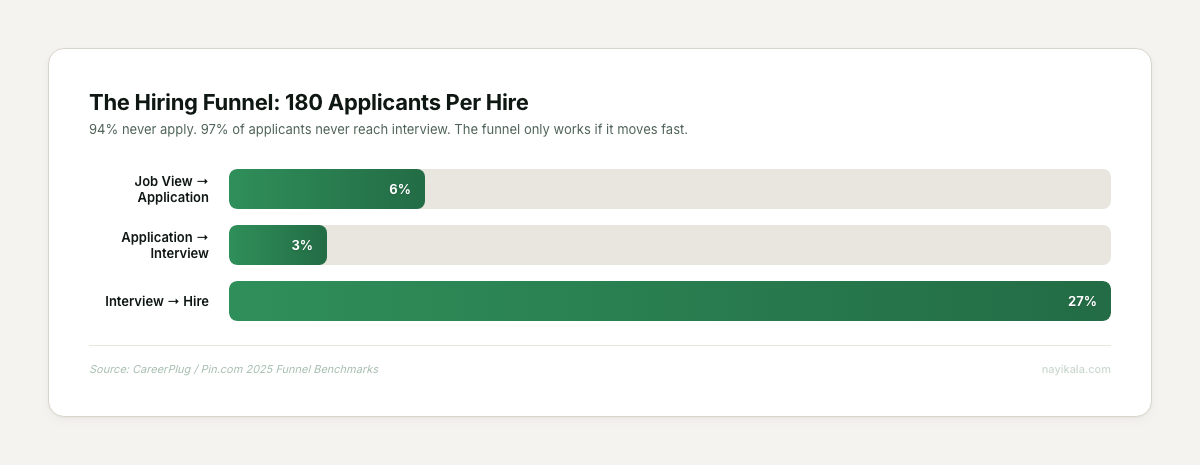
The pipeline is not broken at one point. It is leaking at every stage. CareerPlug’s 2025 funnel benchmarks put the numbers at roughly this: 94% of people who view your job never apply. Of those who apply, 97% never reach an interview. Of those interviewed, 73% do not convert to a hire — about 1 hire per 180 applicants. The funnels we have mapped for SME clients are worse, because the stages are not even defined. That funnel only works if it moves fast. When it does not, the 1-in-180 who was actually right has already accepted another offer.
The WhatsApp trap
WhatsApp hiring works. We have seen it work spectacularly — one EV motor manufacturer in Ahmedabad hired 20 line technicians in a week through village WhatsApp groups, total cost Rs 4,000, where a staffing agency would have charged Rs 50,000 to Rs 1 lakh for half the positions.
But WhatsApp hiring does not scale safely. There is no candidate state. No way to know who applied, who was screened, who was rejected, who is waiting. One manufacturing company that concentrated hiring through a single community WhatsApp network ended up with a workforce drawn entirely from one background. That hiring channel became the organizing infrastructure for collective action they did not anticipate.
The channel is not the problem. The absence of structure around the channel is.
What you can do Monday morning
None of this requires software. It requires a process decision and a shared Google Sheet.
Step 1: Build a single intake sheet. Every candidate, regardless of source — Naukri, WhatsApp referral, LinkedIn, walk-in — gets one row. Columns: name, source, role, date received, date first contacted, date interviewed, outcome. That is it. Do not over-design this.
Step 2: Set a 48-hour first-response rule. Not a policy. A number someone is accountable for. When a resume arrives, someone responds within 48 hours — even if the response is "we received your application, we will get back to you by Friday." The businesses that lose candidates lose them in the silence between application and first contact. 42% of candidates withdraw because scheduling takes too long (Gem.com candidate drop-off analysis, 2025).
Step 3: Time-box your interview rounds. If you need two rounds, both happen within 10 calendar days of first contact. If you need a task round, the candidate gets the brief within 24 hours of clearing round one. The constraint is not quality — it is calendar discipline.
Step 4: Track one metric for four weeks. Days from "resume received" to "offer sent." Just that number. Average it at month-end. The businesses we have seen cut this from 35+ days to under 15 did not buy new tools. They measured the gap, got embarrassed by it, and compressed the dead time between stages.
Step 5: Send rejection messages. Every candidate who interviews and does not get the offer gets a two-line WhatsApp message within 48 hours of the decision. This is not charity — it is pipeline maintenance. That rejected candidate has friends. Those friends are your next applicants. The 2025 Ghosting Index found that 61% of job seekers were ghosted after an interview, up 9 percentage points in one year. Be the company that does not do this.
Where it gets harder
The spreadsheet works until you are hiring for six roles simultaneously across three locations. Then you need candidate state that persists across people — when your ops lead screens someone in Pune and your founder interviews them from Bengaluru, both need to see the same timeline, the same notes, the same stage.
This is where most businesses buy an ATS and assume the problem is solved. It is not. In the implementations we have seen, the ATS gets bought before the hiring process is designed. The tool inherits the chaos.
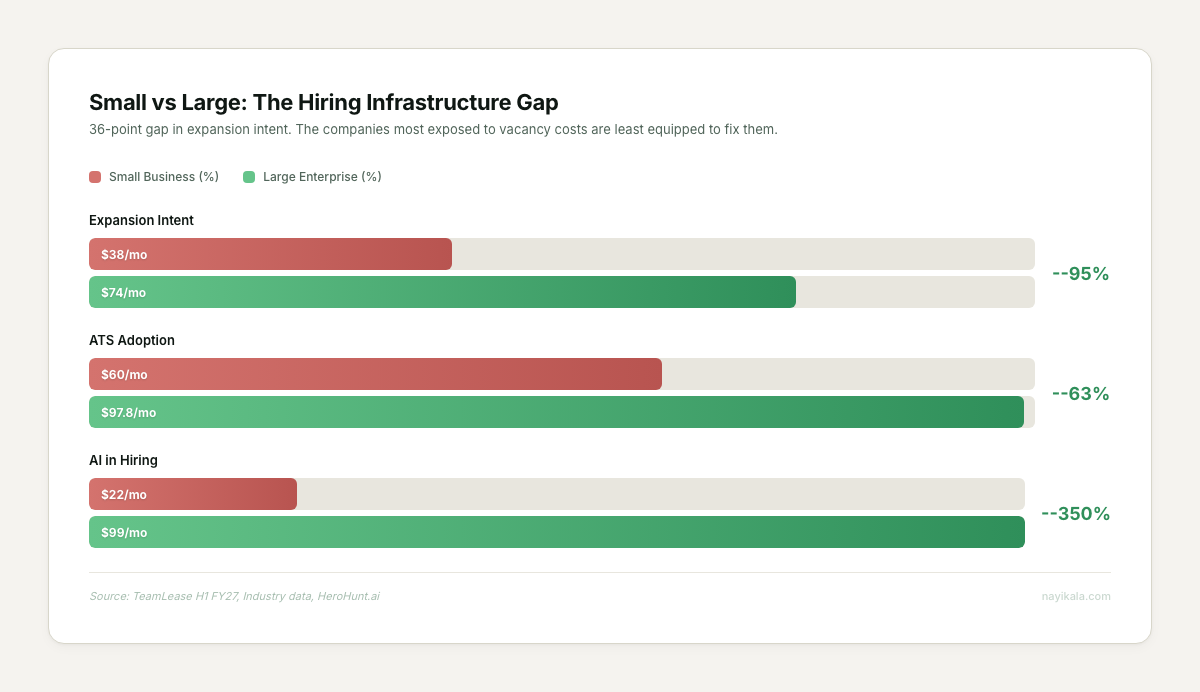
The real design problem is the routing logic underneath. Which roles get which screening criteria. How referral candidates enter the same pipeline as portal candidates without skipping steps. How you enforce your 48-hour response rule when the volume spikes — do you auto-acknowledge and queue, or do you route to a specific person based on role type? What happens to candidate data after rejection — because under the DPDP Rules 2025, you are a Data Fiduciary, rejected candidate data must be deleted within 180 days, and the maximum penalty is Rs 250 crore per violation (full enforcement from May 13, 2027).
Then there is the compliance layer that compounds with every hire. PF kicks in at 20 employees — late payment attracts 12% per annum interest and penal damages up to 25% per annum beyond six months. ESI at 10 employees. TeamLease RegTech’s MSME Compliance Report puts it plainly: 44% of all MSME compliance requirements fall under labour laws, and 32% carry imprisonment risk. The ELI scheme offers real money — up to Rs 15,000 per first-time EPFO registrant — but qualifying requires structured headcount tracking that most manual pipelines cannot produce.
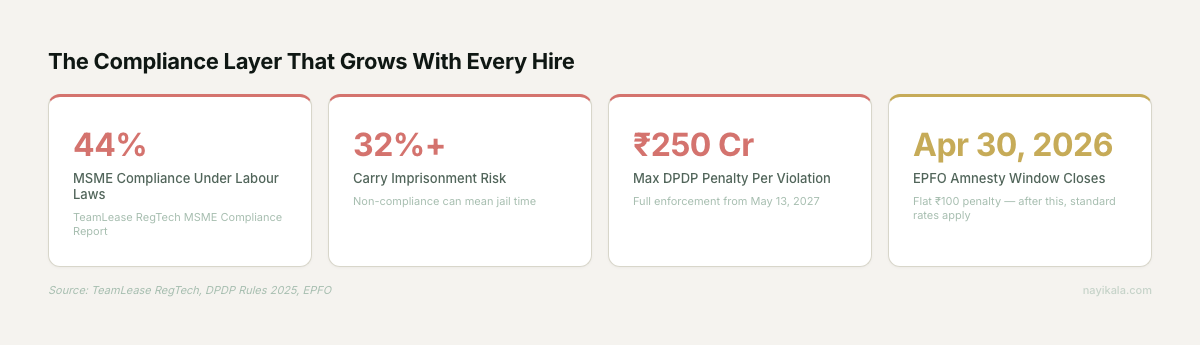
The EPFO Enrolment Campaign amnesty window closes April 30, 2026. That is 19 days from now. The flat Rs 100 penalty covers workers who joined between July 2017 and October 2025 and were never enrolled. After the window closes, the standard penalty structure applies.
None of this is optional complexity. It is the compliance surface area that grows with every hire, and it has to be wired into the pipeline from the first candidate row — not bolted on after onboarding.
The candidate routing logic, the DPDP deletion schedule, and the compliance triggers per headcount threshold are where the actual system design lives.
Related reading
← All posts