
The April 2026 FSSAI amendments eliminated renewal cycles but replaced them with automatic suspension triggers that most food businesses aren't set up to monitor. The compliance surface area didn't shrink — it shifted.
The Renewal Reminder Was Doing More Work Than You Thought
Every food business operator in India had the same ritual. Twelve to eighteen months in, someone — the CA, a compliance consultant, the founder checking WhatsApp at midnight — would flag that the FSSAI license was coming up for renewal. That triggered a scramble: collect documents, log into FoSCoS, pay the fee, upload, wait.
It was inefficient. It was stressful. But it worked as a forcing function. The renewal cycle was the single biggest compliance touchpoint most food businesses had with FSSAI. It forced you to check whether your FoSTaC certificates were current, whether your documentation was in order, whether your address and category details on FoSCoS still matched reality.
As of April 1, 2026, that forcing function is gone.
The Food Safety and Standards (Licensing and Registration) Amendment Regulations, 2026 — gazetted March 10 — introduced perpetual license validity. Your license is now "valid and subsisting" indefinitely, unless suspended, cancelled, or surrendered (Regulation 2.1.7, sub-clause 1, per FSSAI gazette notification RCD-01002/1/2021).
The FSSAI framed this as a simplification. And it is. But what replaced the renewal cycle is a set of triggers that are easier to miss and harder to recover from.
What Actually Changed on April 1
The Threshold Shift
The turnover thresholds for license tiers were revised dramatically. Basic Registration now covers businesses up to ₹1.5 crore turnover (previously ₹12 lakh — a 12.5x increase). State License covers ₹1.5 crore to ₹50 crore. Central License kicks in above ₹50 crore.
FSSAI estimates 3 to 5 lakh businesses will shift from State License down to Basic Registration (per the March 2026 FSSAI press release accompanying the gazette notification). Migration happens automatically in the FoSCoS backend based on self-declarations. No fee, no new application, license numbers stay the same.
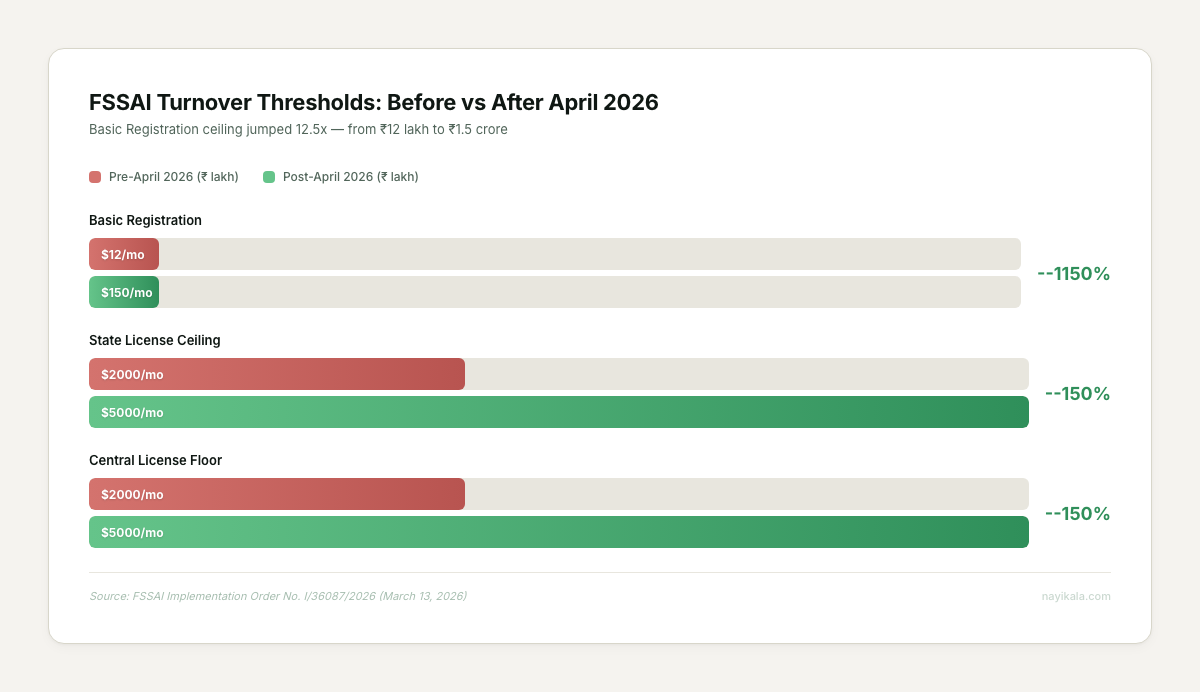
If your turnover puts you in a different tier now, check. The migration is automatic, but the self-declaration that drives it is yours to get right.
The Three Suspension Triggers
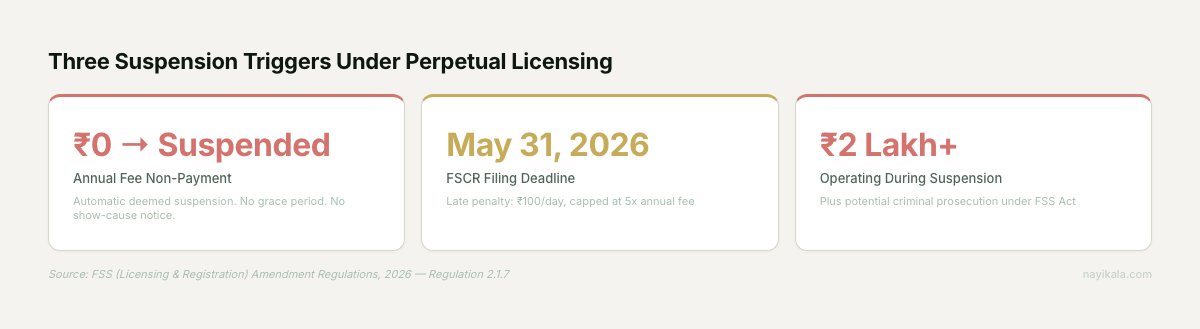
Perpetual doesn't mean permanent. Your license stays valid only if you avoid three triggers:
1. Annual fee non-payment. This triggers automatic deemed suspension. No show-cause notice, no grace period. You cannot legally operate the next day. Operating during suspension is a violation of the FSS Act — penalties up to ₹2 lakh plus potential criminal prosecution (Sections 55/58).
2. Food Safety Compliance Return (FSCR) non-filing. The annual return for FY 2025-26 is due May 31, 2026. Late filing penalty: ₹100 per day, capped at 5x your annual license fee. The businesses we've seen miss this deadline usually don't miss it by choice — they miss it because nobody in the operation owns the calendar.
3. Regulatory non-compliance. Any enforcement action — failed inspection, adulteration finding, consumer complaint that escalates — can terminate your "valid and subsisting" status.
Risk-Based Inspections Are Now Algorithmic
Fixed-schedule inspections are being replaced with a risk-based framework driven by four data inputs: the type of food you handle, your past compliance record, third-party audit scores, and enforcement intelligence (Regulation 2.1.17(2)).
Good compliance history means fewer inspections. Bad history — or high-risk categories like dairy, meat, packaged water, infant food, fishery, eggs — means more frequent, targeted visits. Manufacturers in high-risk categories face mandatory annual third-party audits, at their own expense, through FSSAI-recognized agencies.
The inspection grading runs through FoSCoS scoring. A+ requires 90+ points. Failing any single critical requirement means overall failure regardless of total score. Below 50 points: no grade at all.
What You Can Do Monday Morning
None of this requires a consultant or a software purchase. It requires someone in your operation spending three hours this week.
Check your tier
Log into FoSCoS. Verify that your turnover self-declaration matches your actual numbers. If you're a restaurant doing ₹80 lakh annually, you should now be under Basic Registration, not State License. If the system hasn't migrated you correctly, file for modification before it becomes an inspection discrepancy.
Build a compliance calendar
Three dates matter right now:
- Annual fee payment date — set a reminder 30 days before. Non-payment is automatic suspension. No warning.
- May 31, 2026 — FSCR filing deadline for FY 2025-26. If you filed annual returns late in previous years, you already know the FoSCoS upload process is not intuitive. Start now.
- FoSTaC certificate expiry — these are now valid for only 2 years (changed February 2024). Every food business needs at least one Food Safety Supervisor with a valid certificate. Check when yours expires.
Audit your documentation
FSSAI inspections now score packaging material compliance higher — Certificate of Conformity from NABL-accredited labs went from 2 to 4 points in the revised inspection checklist (Schedule 4 of the 2026 amendment). If you're a manufacturer, get that certificate current. If you're a restaurant, make sure your pest control audit certificate and cold storage calibration certificate are on file and dated within the last year.
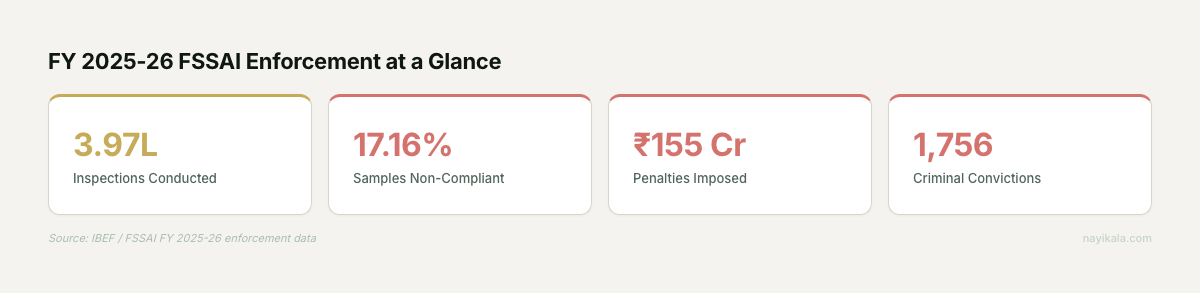
The Blinkit Balewadi closure in Pune last June — reported by local media and confirmed by the Pune FDA — wasn't for contamination. It was for operating without a valid license, food stored on the floor, missing pest control certificates, and missing cold storage calibration records. The documentation gaps are what get you shut down before the food safety issues do.
For cloud kitchen operators: count your licenses
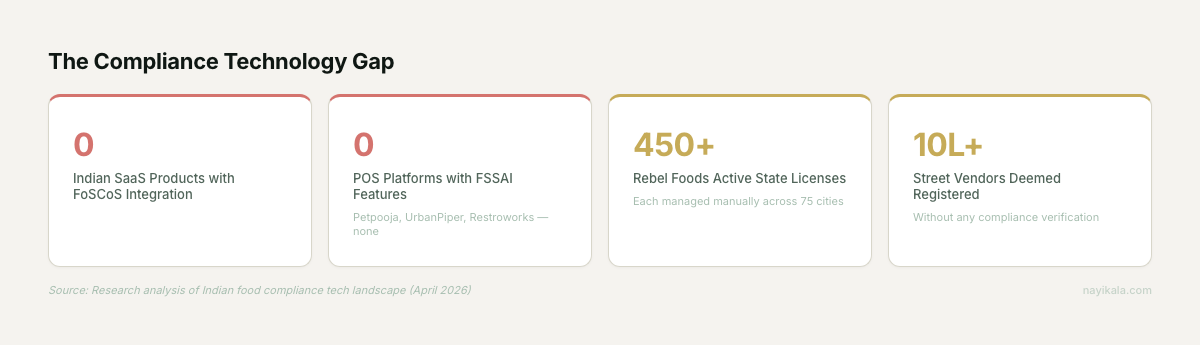
Each location requires its own FSSAI license. Each license has its own compliance obligations. A 10-location cloud kitchen operation means 10 annual fee payments, 10 FSCR filings, 10 inspection surfaces. Rebel Foods reportedly manages 450+ active state licenses across 75 cities — a figure cited in their regulatory filings. The businesses we've seen scale to 5-15 locations almost always have at least one license that's fallen out of compliance — because nobody noticed it was a different entity on FoSCoS.
For one week, list every location, every license number, every fee due date, and every FoSTaC certificate expiry. Put it in a single spreadsheet. That spreadsheet is your compliance surface area.
Where It Gets Harder
The manual calendar works at 1-3 locations. It breaks at 8. It's fictional at 20.
The structural problem isn't awareness — it's that FSSAI compliance generates obligations across multiple independent systems with no native integration between them. FoSCoS is a JavaScript-heavy single-page application with no API. There is no webhook that fires when your annual fee window opens. There is no programmatic way to pull your inspection score or check whether your FoSTaC certificate is approaching expiry. The December 2024 directive requiring licensed manufacturers and importers to submit quarterly data on rejected and expired food items added another reporting surface — also through FoSCoS, also manual.
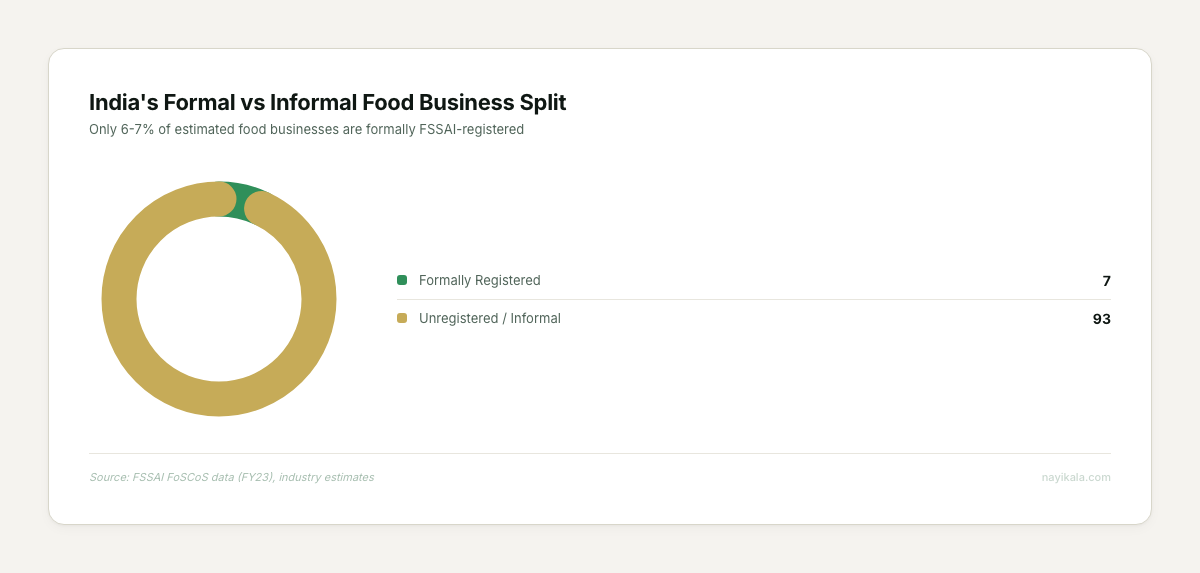
The compliance technology landscape in India reflects this gap. Gridlines offers API-based license verification — useful for platforms onboarding vendors, not for managing your own compliance. Taqtics digitizes SOP checklists and audits but isn't FSSAI-native. myFssai claims to digitize compliance but has no public pricing or documented integrations. No Indian product natively integrates with FoSCoS. No product automates annual return filing. No product tracks inspection readiness scores.
The POS platforms food businesses already use — Petpooja, UrbanPiper, Restroworks — have zero FSSAI compliance features. They handle GST. They handle orders. They don't touch food safety.
What this means operationally: the data that determines whether your license stays active lives in one system, the data that determines your inspection readiness lives in another, your FoSTaC records live in a third, and your documentation for audit lives in a file folder someone created two years ago. When FSSAI's risk-based algorithm flags you for inspection, everything needs to come together in hours. The businesses that fail inspections aren't usually doing unsafe things — they're doing undocumented things.
The integration layer between FoSCoS, your operating systems, and your documentation pipeline is where perpetual licensing either works for you or quietly suspends you.
Related reading
← All posts