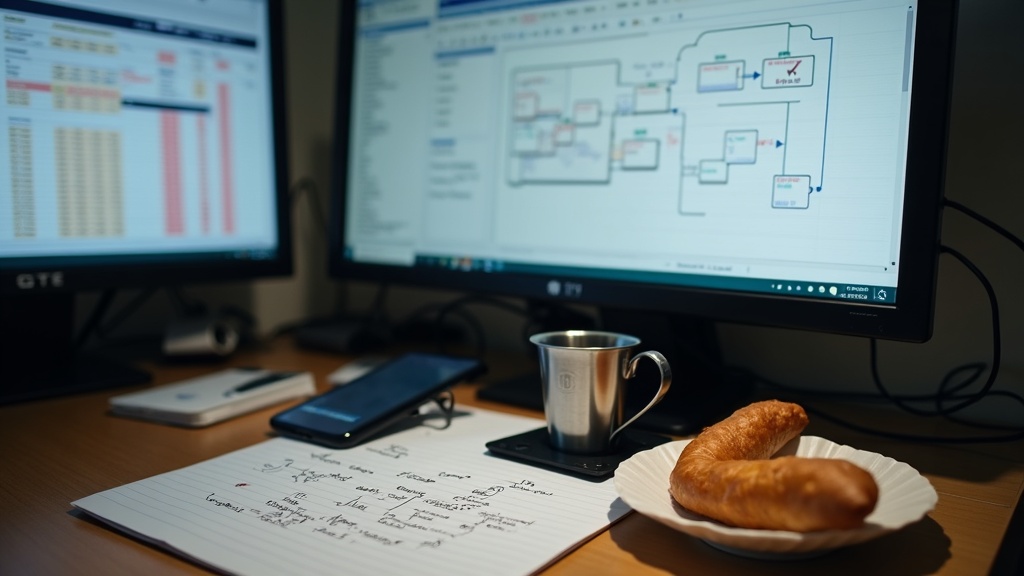
Most Indian SMBs run ads that land in WhatsApp, then let those leads sit for hours. The fix starts with a stopwatch and a spreadsheet, but the real problem is pipeline architecture.
The 2 PM Message That Nobody Sees
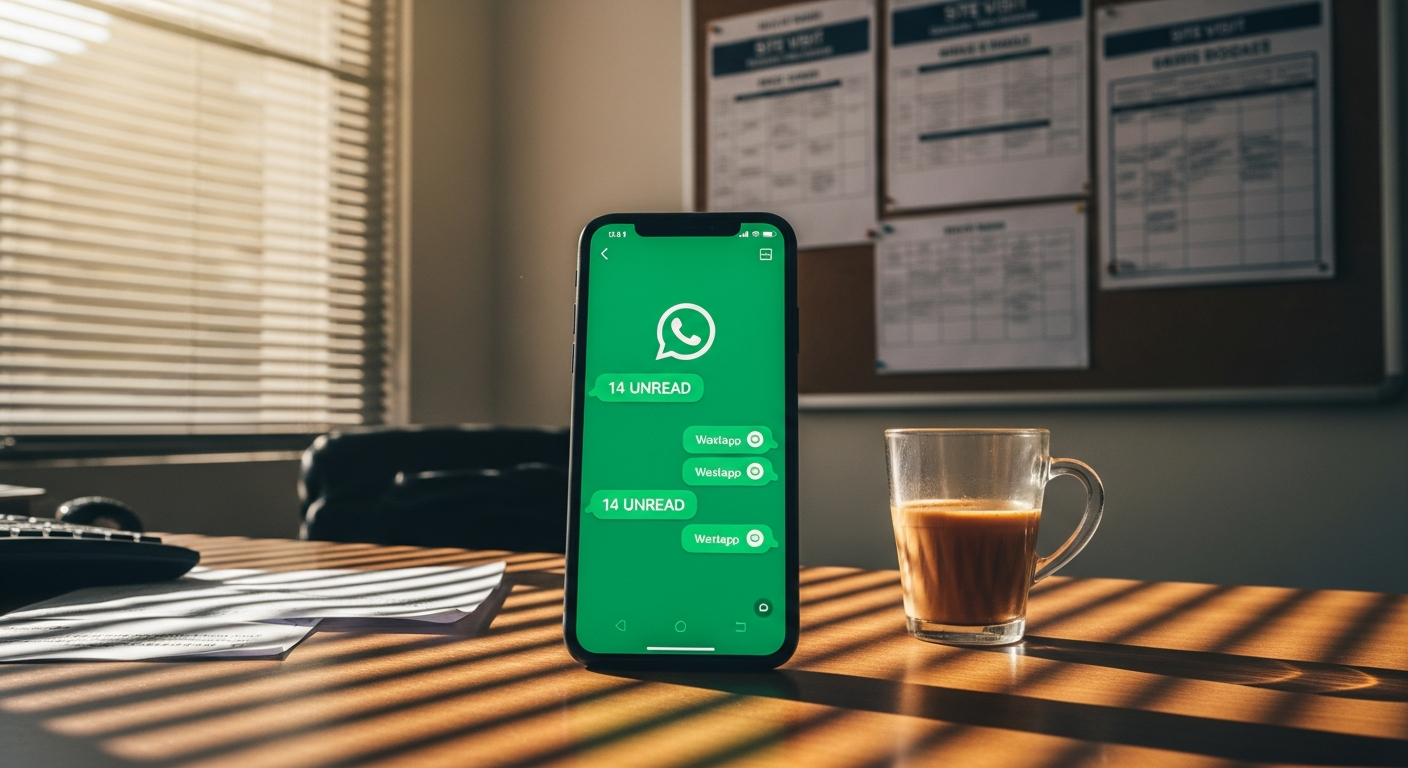
A potential customer taps your Click-to-WhatsApp ad at 2:14 PM. They are sitting in traffic, scrolling through Instagram, mildly interested in your service. They send "Hi, I saw your ad for the 2BHK in Wakad. What’s the price?"
Your sales guy is on a site visit. Your other sales guy is on lunch. The message sits in a shared WhatsApp Business phone that is currently in someone’s back pocket. At 4:47 PM, someone sees it and types "Hi sir, please share your budget and preferred configuration."
By then, the customer has already spoken to two other builders who responded in under five minutes. One of them has a site visit scheduled for Saturday.
This is not a customer service problem. This is a revenue problem that looks like a customer service problem. And it is happening at scale across Indian businesses that spend real money on ads -- real estate firms, coaching institutes, D2C brands, clinics -- all funneling traffic into WhatsApp and then fumbling the handoff.
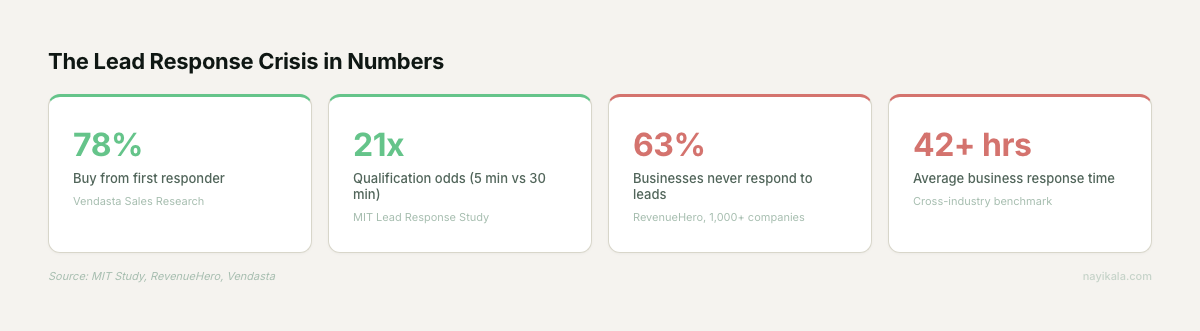
78% of customers buy from the business that responds first, according to Vendasta’s sales research. The MIT Lead Response Management Study found that contacting a lead within five minutes makes you 21 times more likely to qualify them compared to waiting thirty minutes. Not twice as likely. Twenty-one times.
The math is brutal and the window is small.
The Broken Process, Step by Step
Here is what the lead pipeline actually looks like in most Indian SMBs we have worked with.
Step 1: Ad spend. The business runs Meta ads -- often Click-to-WhatsApp ads, which over 200,000 Indian SMBs now use, per Sendwo. The ads work. People click. Messages arrive.
Step 2: The inbox. Messages land in WhatsApp Business, which is installed on one phone, maybe two. There is no queue, no assignment logic, no priority flag. A message from someone ready to buy looks exactly like a message from someone asking if you deliver to their pin code.
Step 3: The human bottleneck. One person -- sometimes the owner, sometimes a junior sales hire -- scrolls through the inbox between other tasks. They respond to whoever they see first, not whoever is most qualified. The message from the high-intent buyer at 2:14 PM gets the same treatment as a "what is your return policy" at 2:16 PM.
Step 4: The follow-up that never happens. Even when someone responds, there is no system tracking whether a follow-up was sent, whether a site visit was booked, whether the lead went cold. The businesses we have seen running this way lose track of leads within 48 hours. Not because they do not care -- because there is no structure to care inside.
Step 5: The reporting fiction. At the end of the month, the owner asks "how many leads did we get from ads?" The answer is a rough count of WhatsApp messages, maybe pulled from a screenshot, maybe from memory. Nobody can tell you how many converted, at what stage they dropped off, or what the cost per qualified lead actually was.
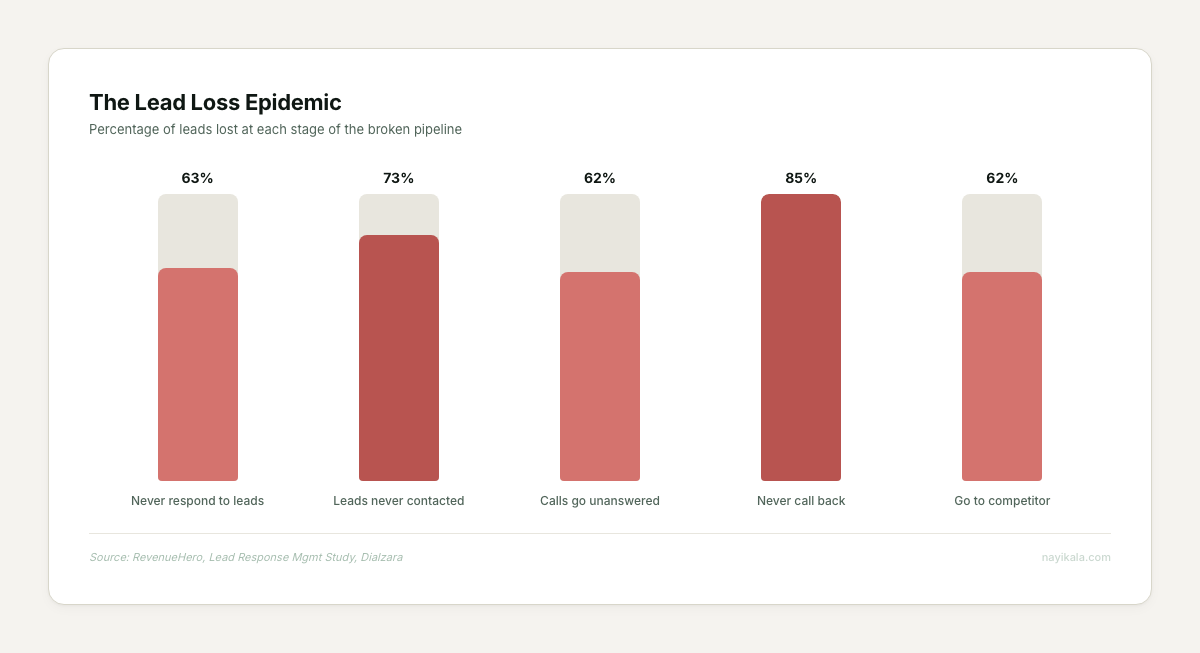
63% of businesses never respond to their leads at all, according to a RevenueHero study across 1,000+ companies. That number sounds impossible until you watch how a real inbox operates on a Tuesday afternoon.
The result: the business pays Rs 600-1,200 per lead in real estate, Rs 200-800 in edtech, and then lets those leads rot in an unstructured inbox. The ads are not failing. The pipeline after the ad is failing.
What You Can Do Monday Morning
You do not need software to start fixing this. You need discipline and a spreadsheet.
Track every message for one week
Open a Google Sheet. Three columns: timestamp of incoming message, timestamp of first response, outcome (booked / qualified / dropped / spam). Have whoever manages the WhatsApp phone fill this in for every single conversation for five business days. Do not skip the ones that feel unimportant.
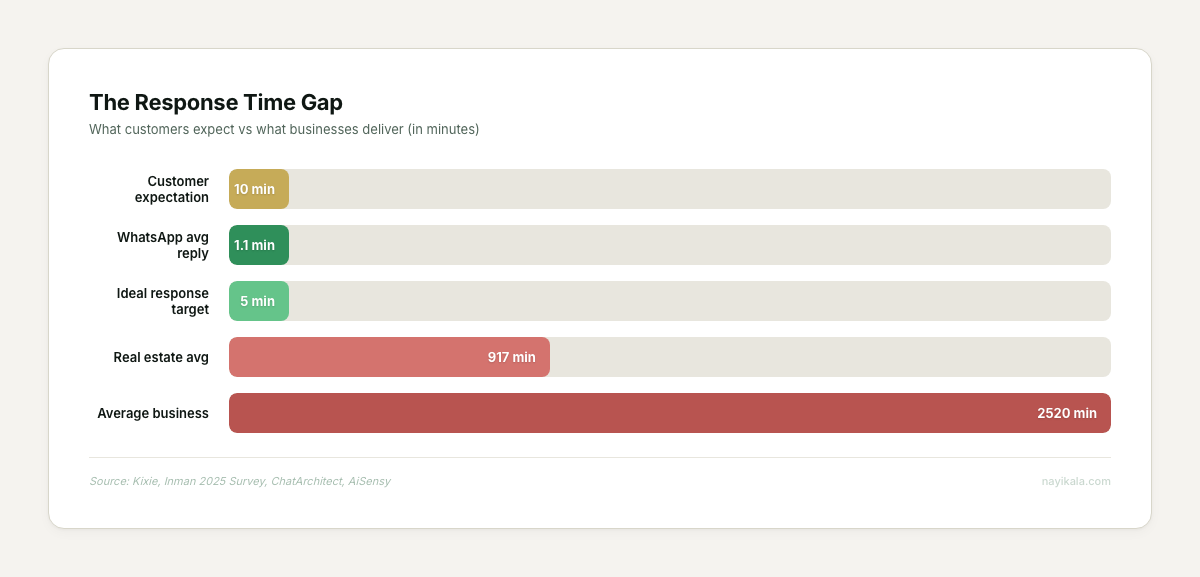
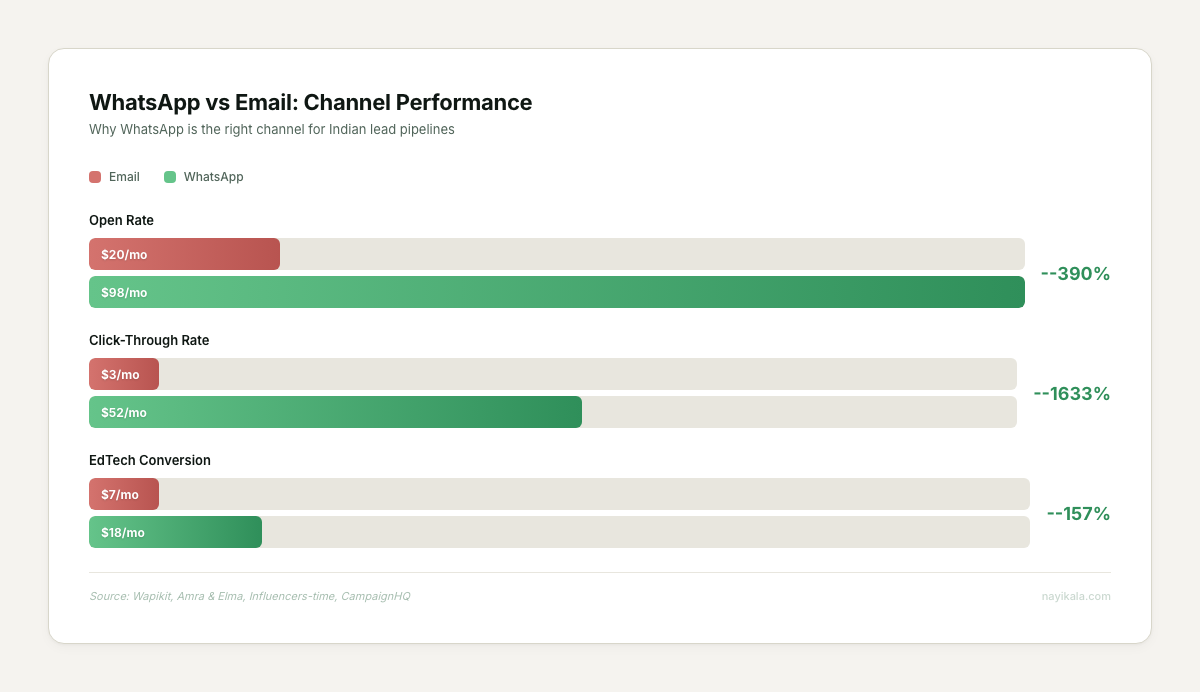
At the end of the week, calculate your average response time. If it is over fifteen minutes, you are leaving conversions on the table. WhatsApp messages that get a response within fifteen minutes convert at significantly higher rates than those that do not, per Wapikit’s 2025 analysis of business messaging data.
Separate inquiry types
Most businesses treat every WhatsApp message the same. They are not the same. A "what is the price of the 3BHK" is a buying signal. A "do you have parking" is an information request. A "hi" with no context is noise.
For one week, tag each message: hot (mentions price, availability, booking), warm (asks specific questions), cold (generic or irrelevant). Then look at how your team is spending time. The businesses we have seen doing this discover that 40-60% of their response time goes to cold or spam messages while hot leads wait.
Set a response time target
Pick a number. Sixty seconds is ideal. Five minutes is acceptable. Fifteen minutes is the outer edge. Write it down. Tell your team. Measure against it daily. This single metric -- first response time -- is the highest-leverage number in your sales operation and almost nobody tracks it.
Use WhatsApp Business labels
The free WhatsApp Business app has a labeling feature that most businesses ignore. Create labels: New Lead, Follow Up Today, Site Visit Scheduled, Closed Won, Closed Lost. Apply them to every conversation. This is not a CRM, but it is better than the alternative, which is nothing.
These steps cost zero rupees. They will surface exactly how broken the pipeline is and give you a baseline to measure any future investment against.
Where It Gets Harder
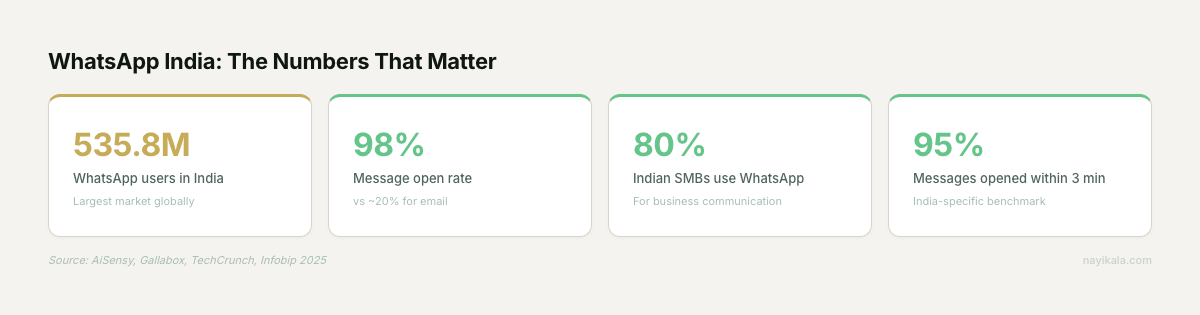
The spreadsheet-and-labels approach works until you hit about 30-50 messages a day. After that, the problems become structural, not behavioral.
Routing logic. When a message arrives, which agent should handle it? The answer depends on the inquiry type, the product line, the customer’s location, the agent’s current load, and whether the agent is even online. Building this as a manual process means someone is triaging all day. Building it as an automated system means you need a classification layer that reads the incoming message, extracts intent, and routes accordingly -- before the customer has waited more than a few seconds.
Qualification at ingress. The businesses we have seen running high volumes need the system to distinguish a qualified lead from an information request before a human ever touches it. This is where an LLM classification layer sits -- parsing the message, extracting structured data (name, budget, location, timeline), scoring the lead, and deciding whether it goes to a human, gets an automated response, or enters a nurture sequence. The output is a JSON object: intent, lead score, extracted fields, routing decision. Getting that schema right, and getting the model to respect it consistently across Hindi, English, and Hinglish -- that is a real engineering problem.
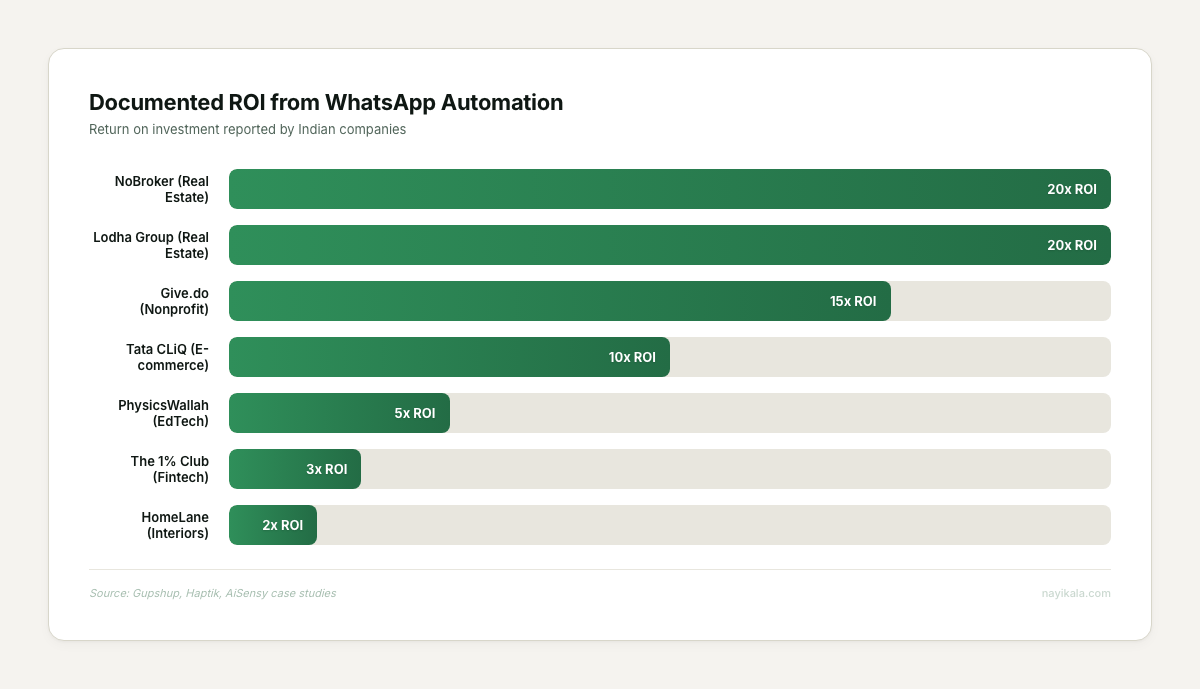
The CRM write-back. Every qualified lead needs to land in a CRM with the conversation context attached. Not just the phone number -- the full transcript, the extracted fields, the qualification score, the timestamp of every interaction. Zoho and Freshsales both have native WhatsApp integrations, but the default setup gives you message logs, not structured lead data. The mapping layer between "WhatsApp conversation" and "CRM lead with pipeline stage" is custom work.
Template compliance and cost control. Meta’s per-message billing went live July 2025, replacing the previous per-conversation model announced in Meta’s pricing update. Marketing templates cost Rs 0.78-1.09 each, per Meta’s published Cloud API pricing as of early 2026. And Meta can reclassify your utility templates as marketing without warning -- a policy change from April 2025, documented in Meta’s Business Help Center -- that turns a Rs 0.115 message into a Rs 0.78 message overnight. The businesses we have seen get burned by this had no monitoring on their template classification status. Their costs tripled in a week and they found out from the invoice.
Consent infrastructure. A pre-checked opt-in box is not consent, per Meta’s own policy documentation. Past SMS consent does not carry over to WhatsApp. Every business-initiated message requires explicit, documented opt-in with disclosure of business name, message types, and opt-out instructions. The businesses that build this as an afterthought end up with phone numbers they cannot legally message and no audit trail to prove compliance.
The webhook architecture alone -- receiving the message from Meta’s Cloud API, validating the HMAC signature, acknowledging with HTTP 200 before processing, pushing to a message queue for async handling, deduplicating on message ID -- is three layers of infrastructure before you have even started thinking about what to do with the message.
The routing logic, the consent audit trail, and the template cost monitoring are where the real design decisions live.
← All posts